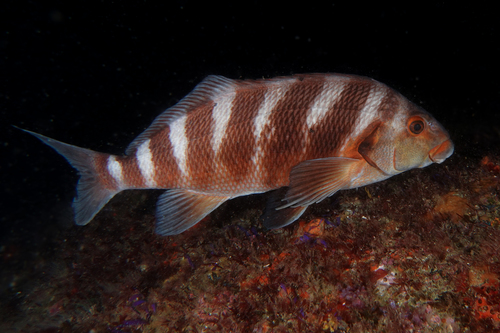
Banded Morwong
Chirodactylus spectabilis
A striking sentinel of the southern kelp forests, the Banded Morwong is an 'old soul' of the reef. With its bold stripes and thick lips, this long-lived fish is a permanent fixture of Australia and New Zealand's rocky coastlines.
Quick Identification
Size
Typically 40–70 cm (16–28 in) in length, reaching up to 100 cm (39 in); weight can exceed 15 kg (33 lbs).
Colors
Pale brownish-grey to reddish-brown background with 7–8 prominent, dark vertical bands; fins often have a reddish or orange tint.
Key Features
- Seven or eight dark vertical bands across the body
- Large, thick, fleshy lips for suction feeding
- Deep, compressed body with a sloping forehead
- Long-lived species reaching up to 95 years of age
When You’ll See Them
Geographic range
Where Does the Banded Morwong Live?
The Banded Morwong is native to the cool, temperate waters of the Southern Hemisphere. Its primary range spans the southern coast of Australia, including the waters of New South Wales, Victoria, Tasmania, and South Australia, as well as the coastal regions of New Zealand. This species is a true local resident, rarely venturing far from the rocky shorelines and kelp-rich reefs of the Tasman Sea.
Basemap © OpenStreetMap contributors
Behavior
The Banded Morwong is a sedentary and territorial resident of temperate rocky reefs. Unlike many pelagic fish, these 'homebodies' tend to stay within a small home range for decades. They are most active during daylight hours, spending their time hovering just above the seabed or resting in crevices and kelp forests. Because they are so long-lived, their presence is often an indicator of a healthy, stable reef ecosystem.
Socially, they are usually solitary or found in small, loose groups. While they aren't aggressive toward humans, they are highly territorial against other morwongs and similar-sized competitors. In marine protected areas, they can become quite bold and curious, making them a favorite subject for underwater photographers and coastal observers.
EverydayEarth exclusive
Camera Tips
Capturing the Banded Morwong on camera requires specialized underwater equipment, such as a waterproof trail camera or a tethered marine camera system. To find them, look for 'high-relief' reefs—areas with large boulders, caves, and plenty of kelp. Mount your camera 0.5 to 1 metre above the seafloor, ideally angled toward a flat, sandy clearing adjacent to the reef where they often forage for invertebrates.
Because these fish are most active during the day, lighting is your biggest challenge. In shallow water (under 10 metres), natural sunlight is often sufficient, but in deeper areas, you will need a camera with strong white-light LEDs or external strobes to bring out the reddish-brown hues of their bands. Without artificial light, they often appear as simple grey-and-white silhouettes on film.
Banded Morwongs are creatures of habit; if you spot one in a particular crevice, it is likely to remain in that area for years. A stationary camera left for several hours is much more effective than a hand-held unit, as it allows the fish to resume its natural territorial patrol. While they are curious, avoid using heavy bait which might attract larger predators that could scare the morwong away; a small mesh bag of crushed shellfish is usually enough to pique their interest.
Similar Species
Species that look similar or are commonly confused with Banded Morwong.
Frequently Asked Questions
Record Banded Morwong at your habitat
Connect a camera to start building your own species record — AI identifies every visitor automatically.