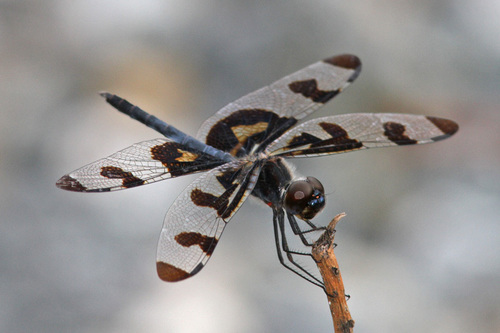
Banded Pennant
Celithemis fasciata
With its artistic black-banded wings and graceful, butterfly-like flight, the Banded Pennant is the crown jewel of the summer pond. Watch for this small but striking sentinel as it perches high above the reeds, guarding your garden from mosquitoes.
Quick Identification
Size
Total length of 29-35 mm (1.1-1.4 inches); wingspan of approximately 55-65 mm (2.2-2.6 inches)
Colors
Deep black or slate-blue body in mature males; females and juveniles are yellowish-brown. Both sexes feature large, irregular black bands across the wings.
Key Features
- Extensive dark black bands and spots covering nearly half of the wing surface
- Slender, dark abdomen that becomes pruinose (waxy blue-black) in mature males
- Distinctive fluttering, butterfly-like flight style
- Habit of perching on the very tips of tall aquatic vegetation
When You’ll See Them
Geographic range
Where Does the Banded Pennant Live?
Native to North America, the Banded Pennant is a quintessential species of the eastern United States. Its range extends from the Atlantic coast westward into the Great Plains, reaching as far as eastern Texas, Oklahoma, and Kansas. While most concentrated in the humid Southeast and Mid-Atlantic states, populations can be found as far north as southern New England and the Great Lakes region, where they thrive in warm, sun-drenched wetlands during the summer months.
Basemap © OpenStreetMap contributors
Behavior
The Banded Pennant is a master of the "pennant" lifestyle, a behavior where the dragonfly perches on the very tip of a tall reed or twig, waving like a small flag in the wind. Unlike many dragonflies that stay close to the water's surface, these skimmers prefer high vantage points to survey their territory for both prey and potential mates. Their flight is noticeably different from the darting motion of other skimmers; it is light, airy, and rhythmic, often described as similar to the flight of a butterfly.
During the hottest parts of the summer day, you may observe them performing an "obelisk" posture. They raise their abdomen vertically toward the sun, which reduces the surface area exposed to direct heat and helps them stay cool without seeking shade. While they are territorial, they are generally not aggressive toward humans and will often return to the same perch repeatedly, even if briefly disturbed.
EverydayEarth exclusive
Camera Tips
To capture the Banded Pennant on camera, you must think like a perching insect. These dragonflies have a strong preference for the highest point in their immediate vicinity. Identify a tall, solitary reed, cattail, or even a garden stake near the edge of a pond. Position your camera on a tripod or mount it so that the lens is level with the top of this perch. Because these dragonflies are small, you will need to set your focus manually on the tip of the perch to ensure the AI-trigger or motion sensor captures a sharp image the moment they land.
Lighting is critical for showing off the intricate black patterns on their wings. These dragonflies are most active in full sun. Try to position your camera with the sun at your back or slightly to the side to highlight the contrast between the dark wing bands and the clear sections of the wing. If you are using a trail camera, ensure it has a fast trigger speed (under 0.5 seconds), as these insects can land and take off in the blink of an eye.
A unique trick for backyard enthusiasts is to create a "photo-op" station. Drive a slender bamboo stake or a stiff piece of wire into the mud at the water's edge, ensuring it stands taller than the surrounding grass. Banded Pennants are almost guaranteed to investigate and use this as a hunting lookout. Setting your camera to a high shutter speed—at least 1/1000th of a second if your device allows manual control—will help freeze their fluttering wings in crystal clarity.
Seasonality plays a major role in your success. In most of their range, Banded Pennants only emerge as adults during the peak of summer. Plan your camera deployments for the hottest weeks of July and August. If you are using an AI-powered camera, make sure the firmware is updated to recognize "Insects" or "Odonata," as their small size and rapid movement can sometimes be filtered out by software designed for larger mammals or birds.
Similar Species
Species that look similar or are commonly confused with Banded Pennant.
Frequently Asked Questions
Record Banded Pennant at your habitat
Connect a camera to start building your own species record — AI identifies every visitor automatically.