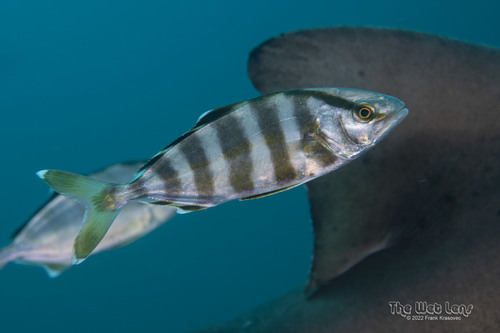
Banded Rudderfish
Seriola zonata
Meet the 'shark pilot' of the Atlantic—a sleek, energetic jack that transitions from a banded juvenile following shadows to a powerful silver adult of the deep reefs.
Quick Identification
Size
Typically 30–50 cm (12–20 in) in length, but can reach 75 cm (30 in); weights usually range from 0.5 to 2 kg, peaking at 5.2 kg (11.5 lbs).
Colors
Adults are bluish-green to brownish-gray on the back with silver-white bellies; juveniles feature six distinct dark vertical bars and a dark stripe through the eye.
Key Features
- 6 dark vertical bands on juveniles
- Prominent dark 'pilot' stripe from eye to dorsal fin
- Slender, streamlined body with a deeply forked tail
- Two dorsal fins, with the second being much longer
When You’ll See Them
Geographic range
Where Does the Banded Rudderfish Live?
Native to the western Atlantic Ocean, the Banded Rudderfish occupies a vast stretch of coastline from the cold waters of Nova Scotia, Canada, down through the Gulf of Mexico and the Caribbean Sea to Brazil. Their core population density is highest along the eastern United States and the South American coast, where they thrive in warm temperate and tropical zones. While primarily a western Atlantic species, they are occasionally spotted in the eastern Atlantic, though no significant introduced populations are established elsewhere.
Basemap © OpenStreetMap contributors
Behavior
The Banded Rudderfish is a highly energetic member of the jack family, famous for its unique association with larger marine life and floating objects. Juveniles exhibit a fascinating 'hitching' behavior, where they follow sharks, large rays, or even slow-moving boats and jellyfish. This behavior provides them with protection from predators and access to leftover food scraps, earning them the local nickname 'shark pilot,' though they are distinct from true pilot fish.
As they mature, these fish become more independent and transition from surface-dwelling hitchhikers to agile hunters of the mid-water column. They are extremely social in their youth, often forming small, tight-knit schools around underwater structures like buoys, pilings, or shipwrecks. While generally wary of large predators, they are known for their curiosity, often approaching divers or underwater camera equipment to investigate movement.
EverydayEarth exclusive
Camera Tips
Capturing the Banded Rudderfish on an underwater trail camera requires focusing on 'structure.' These fish are naturally attracted to vertical lines in the water column, such as pier pilings, buoy chains, or lobster pot lines. Mounting your camera at a depth of 3 to 6 feet on a submerged post or using a weighted tripod near a reef edge is ideal. Angle the lens slightly upward to catch the silver sheen of their bellies against the surface light, which helps significantly with AI species identification.
Since these fish are naturally curious about floating debris, you can increase your success by using a 'chum' bag or a reflective lure. A small piece of shiny metal or a spinning spoon hanging in front of the camera lens can mimic the flash of baitfish, drawing the rudderfish into the frame for a close-up. Unlike some shy species, Banded Rudderfish may actually linger to investigate the camera, so set your device to record short video clips rather than just still photos to capture their fluid schooling behavior.
Visibility is the biggest hurdle for backyard ocean cameras. For the best results, deploy your camera during a rising tide when clearer ocean water is pushed toward the shore or into estuaries. While they are active throughout the day, the 'golden hours' of early morning and late afternoon provide the best contrast for the AI to pick up the juvenile's distinctive bands or the adult's dark eye stripe. Avoid using heavy artificial lighting at night, as it tends to backscatter off particulates; natural sunlight is your best friend for high-quality footage.
Similar Species
Species that look similar or are commonly confused with Banded Rudderfish.
Frequently Asked Questions
Record Banded Rudderfish at your habitat
Connect a camera to start building your own species record — AI identifies every visitor automatically.