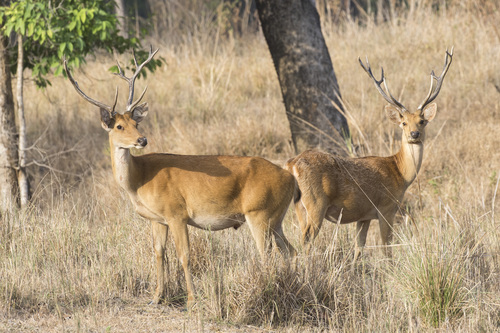
Barasingha
Rucervus duvaucelii
Known as the 'Twelve-Tined' deer, the Barasingha is a majestic wetland specialist of the Indian subcontinent. With its striking orange coat and massive, multi-branched antlers, it is a crown jewel of the eastern grasslands.
Quick Identification
Size
Shoulder height of 110–120 cm (43–47 in); weight ranges from 170–280 kg (370–620 lbs)
Colors
Rufous to yellowish-brown summer coat with faint spots; thicker, darker brown or greyish-brown coat in winter. Males have significantly darker necks.
Key Features
- Large antlers with 10–14 tines (typically 12)
- Splayed hooves adapted for marshy ground
- Long, narrow muzzle
- Orange-brown woolly coat
When You’ll See Them
Geographic range
Where Does the Barasingha Live?
The Barasingha is native to the Indian subcontinent, currently occupying a fragmented range across northern and central India and southwestern Nepal. While they once roamed extensively across the Indo-Gangetic plains, their core populations are now concentrated in protected sanctuaries such as Kanha National Park and the Terai grasslands. These deer are landscape specialists, restricted entirely to southern Asia with no introduced populations elsewhere in the wild.
Basemap © OpenStreetMap contributors
Behavior
The Barasingha is a highly social deer species, typically found in herds ranging from 10 to 20 individuals, though massive congregations of hundreds have been recorded in protected grasslands. They are predominantly grazers and are most active during the early morning and late afternoon, spending the heat of the day resting in tall grass or wallowing in shallow water to cool off and escape biting insects.
During the rutting season, dominant stags become exceptionally vocal, emitting a unique braying call that can be heard across the marshes. Unlike many other deer species, Barasingha are famously associated with water; they are excellent swimmers and will often submerge their heads completely to feed on nutritious aquatic vegetation. Their relationship with humans is largely restricted to protected areas, as they are shy and wary of disturbance.
EverydayEarth exclusive
Camera Tips
To capture high-quality footage of a Barasingha, focus your camera placement on the 'ecotone'—the transition zone where tall grasslands meet marshy water. These deer use established trails through the reeds to reach their feeding grounds. Set your camera at a height of about 3 to 4 feet, angled slightly downward to catch the distinctive splayed hooves and the impressive antler structure of the stags.
Since Barasingha are swamp-dwellers, moisture is your biggest enemy. Ensure your camera housing is fully waterproof and use desiccants inside the case to prevent lens fogging in the high-humidity environment. If you are setting up near a wallow, use a sturdy mounting post rather than a tree, as these deer like to rub their antlers on saplings and may accidentally knock your camera out of alignment.
Early morning light provides the best results for their orange-tinted coats. Set your camera to take short video bursts (15-20 seconds) with a fast trigger speed, as they can move surprisingly quickly through tall grass. Avoid using heavy scents or baits; instead, look for 'deer beds' in the flattened grass, which indicate a frequent resting spot where you can capture more intimate, stationary behavior.
Similar Species
Species that look similar or are commonly confused with Barasingha.
Frequently Asked Questions
Record Barasingha at your habitat
Connect a camera to start building your own species record — AI identifies every visitor automatically.