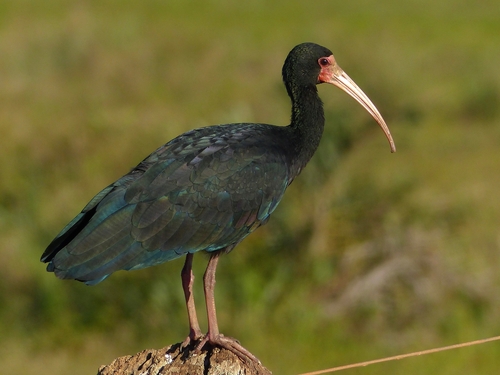
Bare-faced Ibis
Phimosus infuscatus
Meet the 'Whispering Ibis,' a social and striking wading bird known for its iridescent dark feathers and vibrant red face. Common across South American wetlands and pastures, this curious bird is a master of finding hidden treasures in the mud.
Quick Identification
Size
Length: 46–56 cm (18–22 in); Weight: 500–600 g (1.1–1.3 lb)
Colors
Dark brownish-black plumage with a metallic green or bronze iridescence; bright red to orange bare facial skin; yellowish-brown bill and pinkish-red legs.
Key Features
- Bright red bare skin on the face and throat
- Long, downward-curved (decurved) bill
- Iridescent greenish-black plumage
- Reddish-pink legs and feet
When You’ll See Them
Geographic range
Where Does the Bare-faced Ibis Live?
This resilient ibis is native to the South American continent, where it maintains a massive and stable presence across two primary regions. Its range extends through the northern lowlands of Colombia and Venezuela, and more extensively through the central and southern regions including Brazil, Paraguay, Uruguay, Bolivia, and northern Argentina. It is a common sight in the Pantanal and Llanos, thriving in seasonally flooded plains and moist agricultural landscapes.
Basemap © OpenStreetMap contributors
Behavior
The Bare-faced Ibis is a highly social bird, frequently found in small groups or large, bustling flocks. Known for its relatively quiet demeanor, it has earned the nickname 'whispering ibis.' They are often observed in 'mixed-species' groups, foraging alongside herons, egrets, and other wading birds in wetlands or flooded fields. While they are capable fliers, they spend the vast majority of their daylight hours on the ground, methodically searching for food.
These birds are remarkably adaptable and have become quite comfortable around human activity. In suburban environments, they can be seen walking across lawns or golf courses with a rhythmic, steady gait. At night, they congregate in communal roosts, typically in tall trees or thickets near water, where they stay protected from ground predators. Their social structure is most evident during these roosting periods and during the breeding season, when they nest in colonies.
EverydayEarth exclusive
Camera Tips
To capture the Bare-faced Ibis on camera, focus on 'edge' habitats where manicured lawns or pastures meet water or marshland. They are dedicated ground-feeders, so mount your camera low—about 12 to 18 inches off the ground—and angle it slightly upward. This perspective captures the intricate detail of their iridescent feathers and the vibrant texture of their bare red faces, which are often obscured when looking down from a high angle.
If you are trying to attract them to a specific backyard spot, moisture is your best friend. A small, muddy depression or a shallow water feature with soft, wet soil around the edges will naturally draw them in as they search for earthworms and larvae. They are most active in the early morning and late afternoon, so ensure your camera is positioned to avoid direct lens flare during these golden hours. Using a fast shutter speed or a high-frame-rate video setting is recommended to catch the rapid, rhythmic 'sewing machine' motion of their bills as they probe the mud.
Because these birds are social, one ibis usually means more are nearby. Set your camera's burst mode to take 3-5 photos per trigger; this ensures you get at least one shot where the bird's head is up and the eye is visible, as they spend much of their time with their faces buried in the grass. In terms of seasonality, keep your gear ready after heavy rainstorms; the Bare-faced Ibis often emerges in suburban areas to exploit the worms and grubs driven to the surface by saturated soil.
Similar Species
Species that look similar or are commonly confused with Bare-faced Ibis.
Glossy Ibis
The Glossy Ibis is slightly larger with a rich chestnut-brown body and lacks the extensive bright red bare facial skin of the Bare-faced Ibis.
Green Ibis
The Green Ibis has a much heavier build, a shorter and thicker bill, and lacks the red face and legs, appearing overall much darker and more uniform.
Frequently Asked Questions
Record Bare-faced Ibis at your habitat
Connect a camera to start building your own species record — AI identifies every visitor automatically.