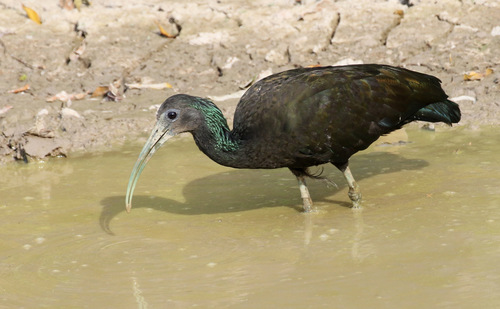
Green Ibis
Mesembrinibis cayennensis
A shadow of the tropical twilight, the Green Ibis is a master of camouflage in the muddy riverbanks of the Neotropics. With its emerald-tinged plumage and haunting rhythmic call, this elusive wader brings the mystery of the deep swamp to your backyard camera.
Quick Identification
Size
Length of 48–58 cm (19–23 in); Weight 700–915 g (1.5–2.0 lbs); Wingspan approx. 75 cm (30 in)
Colors
Glossy greenish-black plumage with metallic bronze and emerald highlights; dull grey-green legs and bill; dark brown eyes.
Key Features
- Distinctive metallic bottle-green sheen on dark feathers
- Shorter, stouter legs than most other ibis species
- Long, decurved (downward-curving) bill
- Heavily hunched posture when foraging or perched
When You’ll See Them
Geographic range
Where Does the Green Ibis Live?
The Green Ibis is a quintessential Neotropical species, spanning a vast territory from Central America down through the heart of South America. Its range begins in the humid lowlands of Honduras and Nicaragua, extending through Costa Rica and Panama into the South American continent. It is widely distributed across the Amazon Basin, covering countries like Brazil, Colombia, and Peru, and reaches its southern limits in the wetlands of northern Argentina and Paraguay. While it is a lowland specialist, it is rarely found in open coastal marshes, preferring the sheltered, wooded interior of the continent.
Basemap © OpenStreetMap contributors
Behavior
The Green Ibis is a notably more reclusive and solitary bird than its more famous white or scarlet cousins. Often found alone or in mated pairs, it shuns the massive communal flocks typical of the ibis family. It is primarily crepuscular, meaning it is most active during the dim light of dawn and dusk, though it will forage throughout the day in the deep shade of the rainforest canopy.
In terms of social interaction, these birds are highly territorial regarding their foraging spots along riverbanks. They are famous among birdwatchers for their loud, raucous calls—a rhythmic 'cor-cor-cor'—that often echoes through the jungle before the bird is even seen. While they are generally shy around humans, they can become accustomed to quiet observers if their habitat remains undisturbed.
EverydayEarth exclusive
Camera Tips
To capture the Green Ibis on a trail camera, you must focus on 'edge habitats' where the forest meets standing water or slow-moving streams. Unlike other herons or ibises that stand in the middle of open water, the Green Ibis prefers to stick to the muddy margins under the cover of overhanging branches. Place your camera 12–18 inches off the ground, angled slightly downward toward a known mudflat or a break in the riverbank vegetation where the soil remains moist.
Because this species is most active during low-light hours, your camera's Infrared (IR) performance is critical. Ensure your camera is set to a 'High' or 'Very High' trigger sensitivity, as these birds move with a slow, deliberate probing motion that can sometimes fail to trigger less sensitive sensors. If your camera allows for video, set it to 15–20 second clips; the way they use their bill to 'feel' for food in the mud is a fascinating behavior that static photos often miss.
Baiting is generally not recommended or effective for this species as they respond to live, moving prey under the mud. Instead, look for 'probe holes'—small, circular indentations in soft mud—as a sign that a Green Ibis has recently visited the area. During the dry season, they will frequent the last remaining puddles in a drying swamp, making these locations 'gold mines' for camera placement. Avoid using white-flash cameras, as this shy species is easily spooked and may not return to the spot for several days if startled.
Similar Species
Species that look similar or are commonly confused with Green Ibis.
Frequently Asked Questions
Record Green Ibis at your habitat
Connect a camera to start building your own species record — AI identifies every visitor automatically.