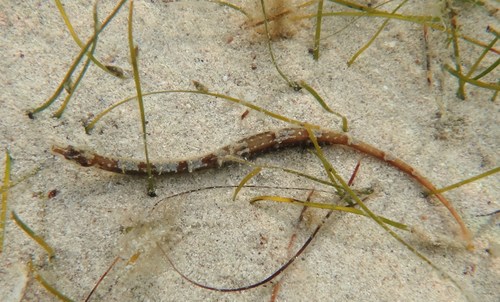
Barred Pipefish
Syngnathus auliscus
A cryptic master of disguise, the Barred Pipefish drifts like a blade of grass through the shallow estuaries of the Eastern Pacific. This armored relative of the seahorse proves that some of the most fascinating 'backyard' wildlife is found just beneath the water's surface.
Quick Identification
Size
A slender fish reaching up to 18 cm (7.1 inches) in length, with a body width often less than a standard pencil.
Colors
Base color varies from pale tan to olive green or dark brown, accented by distinct dark vertical bars along the body and tail.
Key Features
- Elongated, tube-like snout with a small terminal mouth
- Slender body encased in bony, ring-like armor
- Dark vertical bands or bars along the flanks
- Small, fan-shaped tail fin used for steering
When You’ll See Them
Geographic range
Where Does the Barred Pipefish Live?
The Barred Pipefish is a native resident of the Eastern Pacific Ocean's coastal fringes. Its range begins in the temperate waters of Southern California and extends southward through the Gulf of California, hugging the tropical coastlines of Mexico and Central America before reaching its southern limit in northern Peru. This species is a true shallow-water specialist, rarely venturing far from the protective cover of nearshore vegetation and estuarine mudflats.
Basemap © OpenStreetMap contributors
Behavior
The Barred Pipefish is a master of mimicry, spending much of its life hovering vertically among blades of seagrass or eelgrass. This 'statue-like' behavior allows it to blend perfectly with its surroundings, protecting it from larger predators like bass or herons while allowing it to ambush tiny prey. Because they are weak swimmers, they rely on the rapid undulation of their dorsal fin to glide through the water with minimal disturbance.
Socially, these fish are fascinating due to their 'reverse' parental roles. During the breeding season, females deposit eggs into a specialized brood pouch located on the underside of the male's tail. The male then fertilizes, protects, and nourishes the developing embryos for several weeks until they emerge as fully formed, miniature versions of the adults. They are generally solitary but can be found in high densities where seagrass beds are healthy.
EverydayEarth exclusive
Camera Tips
Capturing the Barred Pipefish on camera requires an underwater setup, such as a GoPro or a specialized aquatic trail camera. The best placement is inside a shallow estuary or tide pool during a rising tide. Use a weighted tripod or a heavy sandbag mount to keep the camera steady against the current. Position the lens just inches away from a patch of eelgrass or near a pier piling, as these fish are small and easily lost in a wide shot.
Lighting is your biggest challenge underwater. If you are in a backyard setting with a dock, try to set up your camera during the brightest part of the day when the sun can penetrate the shallow water. Avoid using heavy artificial baits; instead, look for areas where small 'clouds' of tiny shrimp congregate, as the Barred Pipefish will naturally drift toward these feeding zones. A macro lens or a close-up filter is highly recommended to capture the intricate details of their bony rings and snout.
Patience is key because of their cryptic nature. Set your camera to a high frame rate (at least 60fps) to catch their 'snicking' feeding motion, which happens in the blink of an eye. If the water is murky, try placing the camera facing 'up-current' so the water clears the lens of debris. Check your housing seals meticulously, as even a small leak in brackish water can ruin your equipment.
Similar Species
Species that look similar or are commonly confused with Barred Pipefish.
Frequently Asked Questions
Record Barred Pipefish at your habitat
Connect a camera to start building your own species record — AI identifies every visitor automatically.