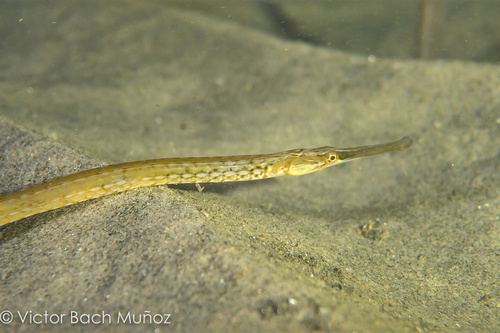
Kelp Pipefish
Syngnathus californiensis
A cousin of the seahorse, the Kelp Pipefish is the Pacific's most slender master of disguise. These needle-shaped fish drift effortlessly through underwater forests, perfectly mimicking the vegetation they call home.
Quick Identification
Size
Typically 15 to 30 cm (6 to 12 inches), with some individuals reaching up to 50 cm (20 inches).
Colors
Highly variable to match surroundings, ranging from olive-green to dark brown with yellowish undersides; some display dark spots or thin horizontal lines.
Key Features
- Slender, needle-like body with segmented bony plates
- Elongated, tube-like snout with a tiny mouth
- Lack of a pelvic fin and a small, fan-shaped tail
- Prehensile tail used for gripping kelp fronds
When You’ll See Them
Geographic range
Where Does the Kelp Pipefish Live?
The Kelp Pipefish is a native resident of the eastern Pacific Ocean, found exclusively along the western coast of North America. Its core range begins in the cool temperate waters near Bodega Bay in Northern California and extends southward through the vibrant kelp forests of Southern California to the subtropical shores of southern Baja California, Mexico. They are strictly marine and rarely stray far from the coastal shelf where their preferred vegetative cover is abundant.
Basemap © OpenStreetMap contributors
Behavior
The Kelp Pipefish is a master of mimicry, spending much of its life floating vertically within kelp forests to perfectly imitate the swaying blades of giant kelp. This behavior is its primary defense against predators, as its rigid, armored body makes it a difficult meal to spot and swallow. They are sluggish swimmers, relying on the rhythmic undulation of their small dorsal fins to navigate the complex underwater jungles of the Pacific.
Socially, Kelp Pipefish are fascinating because they exhibit sex-role reversal in parental care. After a courtship dance, the female deposits her eggs into a specialized brood pouch on the male's underside. The male then fertilizes, protects, and provides nutrients to the developing embryos until they are ready to hatch as miniature versions of the adults. This strategy increases the survival rate of the young in the turbulent coastal environment.
EverydayEarth exclusive
Camera Tips
Capturing the Kelp Pipefish on an underwater backyard or pier-mounted camera requires a focus on 'edge habitats.' These fish frequent the transition zones where eelgrass or kelp meet sandy patches. For the best results, mount your camera at a low angle, roughly 1 to 2 feet above the seafloor, looking horizontally through the vegetation rather than downward. This perspective allows the camera to catch the silhouette of the fish as it hangs vertically among the swaying fronds.
Because Kelp Pipefish are incredibly thin and well-camouflaged, high-resolution settings (4K if possible) are essential for your AI to distinguish them from the background. They move slowly and subtly, so using a high-contrast setting can help highlight the bony, segmented texture of their skin against the smoother surface of the kelp. If your camera is in a shaded area, consider using a soft, diffused external light to bring out their olive-green tones without creating harsh shadows that might spook them.
While you cannot use standard bait for pipefish, you can attract their natural prey. A dim, low-lumen LED light left on during the early morning hours can attract swarms of tiny copepods and mysid shrimp. The Kelp Pipefish will often drift into the camera's field of view to take advantage of this concentrated food source. Be sure to clean your camera lens weekly, as biofouling and algae growth in these nutrient-rich waters can quickly obscure the fine details needed to identify these slender creatures.
Similar Species
Species that look similar or are commonly confused with Kelp Pipefish.
Frequently Asked Questions
Record Kelp Pipefish at your habitat
Connect a camera to start building your own species record — AI identifies every visitor automatically.