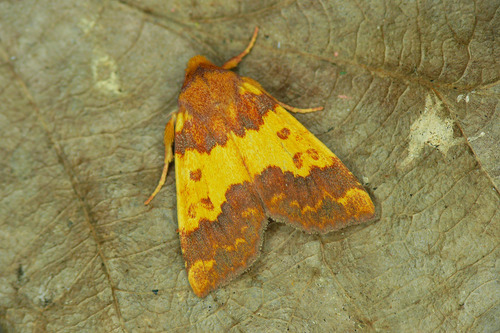
Barred Sallow
Tiliacea aurago
The Barred Sallow is a living leaf, sporting the brilliant golds and rich purples of the autumn forest. This nocturnal beauty is a favorite of backyard observers throughout Europe during the harvest season.
Quick Identification
Size
Wingspan of 30–35 mm (1.2–1.4 inches); length of approximately 15–18 mm (0.6–0.7 inches)
Colors
Brilliant golden-yellow to deep orange forewings with a broad, contrasting purplish-brown or reddish-central band and basal area.
Key Features
- Vibrant golden-yellow forewings
- Broad purplish or reddish-brown central band
- Wavy cross-lines between colored sections
- Rests with wings held in a steep 'tent' shape over the back
When You’ll See Them
Geographic range
Where Does the Barred Sallow Live?
The Barred Sallow is a native European species with a broad distribution stretching from the British Isles and the Iberian Peninsula in the west, across Central Europe, and into the Balkans. While it is widely found across the continent, it is most prolific in the southern and central regions where its primary host trees are most common. In the United Kingdom, it is a frequent sight in the southern half of the country, though its range has been gradually expanding northward into Scotland.
Basemap © OpenStreetMap contributors
Behavior
The Barred Sallow is a nocturnal moth that perfectly embodies the spirit of autumn. Emerging in late August and peaking in September and October, these moths have evolved to mimic the changing colors of falling leaves. During the day, they rest motionless on tree trunks or among leaf litter, where their vibrant yellow and brown patterns provide exceptional camouflage against the mottled colors of the forest floor.
As darkness falls, the Barred Sallow becomes an active flyer, seeking out sugar-rich food sources to fuel its search for a mate. Unlike many other moths that are purely attracted to artificial light, this species is particularly fond of 'sugaring'—feeding on fermented fruit or sap. They are generally solitary but may congregate in small numbers where late-blooming nectar sources, such as ivy, are abundant.
EverydayEarth exclusive
Camera Tips
To capture the Barred Sallow on your backyard camera, timing is everything. This moth is strictly seasonal, appearing only in late summer and autumn. Because they are highly attracted to 'sugar,' the best way to bring them into frame is to use a fermented bait. You can create a simple 'moth wine' by mixing brown sugar, dark beer, and mashed bananas. Paint this mixture onto a tree trunk or a wooden post at roughly eye level (4–5 feet) and point your camera toward the bait station.
Since these moths are small, you will need to set your camera to its macro or close-focus mode if available. If you are using a trail camera, ensure it is positioned no more than 1–2 feet away from the bait to capture the intricate wing patterns. Using a camera with a 'no-glow' or black LED infrared flash is recommended to avoid startling other nocturnal wildlife, though moths generally aren't bothered by standard IR flashes.
Placement near Ivy (Hedera helix) is another winning strategy. Ivy blooms in the autumn and is one of the Barred Sallow's favorite nectar sources. Aim your camera at a patch of flowering ivy on a warm, still night. Check your footage particularly on overcast nights with high humidity, as moths are significantly more active in these conditions compared to clear, cold nights when temperatures drop below 10°C (50°F).
Similar Species
Species that look similar or are commonly confused with Barred Sallow.
Frequently Asked Questions
Record Barred Sallow at your habitat
Connect a camera to start building your own species record — AI identifies every visitor automatically.