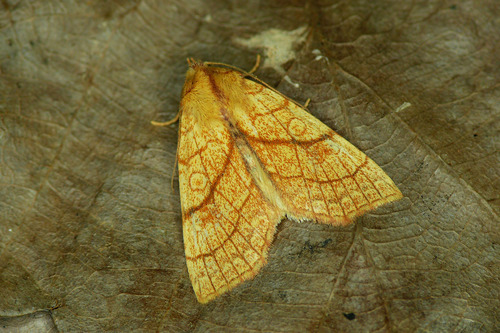
Orange Sallow
Tiliacea citrago
With its vibrant golden-orange wings, the Orange Sallow is a true jewel of the autumn night. This moth is a master of disguise, perfectly mimicking the falling leaves of the Lime trees it calls home.
Quick Identification
Size
Wingspan ranging from 28 to 35 mm (1.1 to 1.4 inches)
Colors
Vibrant orange-yellow or golden-yellow forewings with reddish-brown wavy cross-lines; hindwings are pale whitish-yellow.
Key Features
- Bright golden-orange forewings with reddish-brown wavy lines
- Prominent kidney-shaped mark (stigma) near the wing center
- Fringed wing edges with a darker reddish tint
- Strong association with Lime (Linden) trees
When You’ll See Them
Behavior
The Orange Sallow is a classic autumn moth, known for its striking coloration that perfectly mimics the changing leaves of its favorite host tree, the Lime (Linden). Unlike many other moths that peak in the summer, this species waits until the cooling nights of September and October to take flight. It is largely nocturnal and is a frequent visitor to gardens, though it spends much of its time in the canopy of deciduous trees.
As an adult, it doesn't just rely on flowers; it is highly attracted to fermenting juices, such as those found in overripe fruit or the nectar of late-blooming ivy. While they aren't social in the traditional sense, you might find several congregating around a particularly rich food source on a mild autumn evening. They are gentle creatures that pose no threat to humans or garden plants other than the specific trees their larvae feed upon.
EverydayEarth exclusive
Camera Tips
Capturing the Orange Sallow on an AI-powered camera requires a specific autumn strategy. Since these moths are strongly attracted to 'sugar,' one of the best ways to bring them into frame is by painting a 'sugar patch' on a tree trunk or a fence post within the camera's view. A mixture of dark brown sugar, stale beer, and a bit of overripe banana or treacle works wonders. Position your camera about 3 to 4 feet away from the bait, angled slightly downward to catch the moth as it lands to feed.
Lighting is crucial for insect photography. If your camera has an infrared (IR) night vision mode, it will capture the moth's activity without startling it, though you will lose the brilliant orange color in the footage. For the best results, use a camera with a 'starlight' sensor or a very low-glow white light trigger to highlight those golden-yellow wings. Ensure your trigger speed is set to the fastest possible setting, as moths can be erratic and quick when approaching a light or food source.
Place your camera setup near Lime (Linden) trees if you have them, or near patches of flowering Ivy, which is a natural magnet for this species in late autumn. Because the Orange Sallow flies during the cooler months of September and October, make sure your camera batteries are fresh, as cold nights can drain them faster. A height of 4 to 5 feet is usually ideal, as these moths often descend from the canopy to forage nearer to the ground level.
Similar Species
Species that look similar or are commonly confused with Orange Sallow.
Frequently Asked Questions
Record Orange Sallow at your habitat
Connect a camera to start building your own species record — AI identifies every visitor automatically.