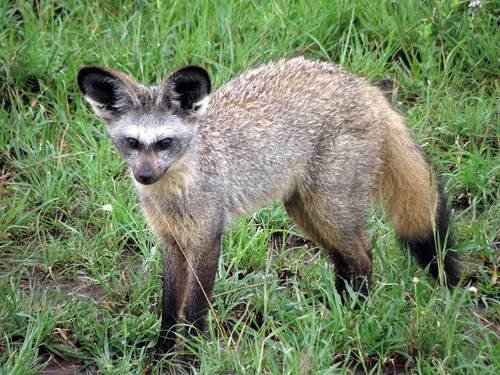
Bat-eared Fox
Otocyon megalotis
With ears like satellite dishes and a specialized diet of termites, the Bat-eared Fox is one of Africa's most fascinating and social insectivores.
Quick Identification
Size
46–66 cm (18–26 in) long; 30–40 cm (12–16 in) tall; 3–5.3 kg (6.6–11.7 lbs)
Colors
Yellowish-brown to silver-gray fur; black ears, feet, and tail-tip; black raccoon-like mask around the eyes
Key Features
- Massive dish-shaped ears up to 5 inches long
- Black stockings on all four legs
- Small, specialized teeth for grinding insects
- Distinct black mask across the face
When You’ll See Them
Geographic range
Where Does the Bat-eared Fox Live?
The Bat-eared Fox is native to the African continent, occurring in two distinct populations separated by the moist forest regions of Central Africa. The eastern population stretches across Ethiopia, Kenya, and Tanzania, while the southern population covers South Africa, Namibia, Botswana, and Zimbabwe. This unique distribution suggests they once inhabited a continuous dry corridor that existed thousands of years ago.
Basemap © OpenStreetMap contributors
Recorded on EverydayEarth
Behavior
The Bat-eared Fox is a highly social canid, often found in monogamous pairs or small family groups. Unlike many other fox species, they are not particularly territorial and are known for their frequent social grooming and playful interactions. They are the only canids that have largely abandoned hunting larger prey in favor of a specialized insectivorous lifestyle.
Their daily rhythm is dictated by the temperature and the activity of their favorite food: harvester termites. In the scorching summer months, they are primarily nocturnal or crepuscular, emerging at dusk to forage. During the colder winter months, they shift to a diurnal schedule to follow the movement of insects during the warmest parts of the day. They are generally shy and will retreat to their complex underground burrows at the first sign of danger.
EverydayEarth exclusive
Camera Tips
To capture the best footage of these low-profile foragers, place your camera significantly lower than you would for a deer or a jackal. Aim for a height of about 12 to 15 inches (30-40 cm) off the ground. This low angle ensures you capture their most striking feature—those enormous ears—without looking down on the animal. Because they spend so much time with their heads down listening for insects, a low-angle shot provides a much better view of their facial markings.
Scout for areas with short grass or bare patches near termite mounds. Bat-eared Foxes use their hearing to detect larvae underground, so they often linger in areas where the soil is disturbed. If you are on a ranch or large property, setting cameras near well-used burrows (which often have multiple entrances) is a surefire way to see social behavior. Look for flattened grass and 'latrine' areas nearby where the foxes congregate.
In terms of settings, use a 'No-Glow' or high-frequency infrared flash. Their eyes and ears are incredibly sensitive, and a visible red glow might cause them to avoid the area in the future. Because they move in erratic, zig-zag patterns while foraging, a fast trigger speed (under 0.3 seconds) and a multi-shot burst mode are essential. This allows you to catch the moment they stop, tilt their head to listen, and suddenly pounce on a subterranean snack.
While traditional meat baits are ineffective for this species, they are highly attracted to insect activity. If legal in your area, a small, low-powered UV light or 'bug zapper' (with the zap turned off) placed near the camera can attract the beetles and moths that these foxes love to snack on, keeping them in the frame for longer durations.
Similar Species
Species that look similar or are commonly confused with Bat-eared Fox.
Frequently Asked Questions
Record Bat-eared Fox at your habitat
Connect a camera to start building your own species record — AI identifies every visitor automatically.