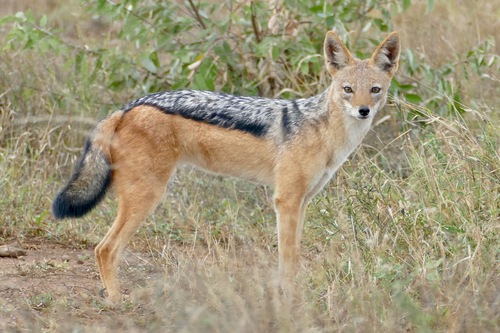
Black-backed Jackal
Lupulella mesomelas
The Black-backed Jackal is a master of the African landscape, known for its striking silver-flecked saddle and haunting evening howls. This resilient and intelligent canid thrives everywhere from the deep desert to the suburban fringe, proving itself to be one of nature's ultimate survivors.
Quick Identification
Size
Length: 60-90 cm (24-35 in); Shoulder height: 38-48 cm (15-19 in); Weight: 6-13 kg (13-29 lbs)
Colors
Rusty-red to golden flanks and legs, with a prominent black 'saddle' on the back heavily flecked with silver-white hair. The tail is bushy and ends in a black tip.
Key Features
- Distinct black and silver-flecked saddle across the back
- Large, pointed upright ears for acute hearing
- Bushy tail with a solid black tip
- Slender, fox-like build with long, reddish legs
When You’ll See Them
Sightings on EverydayEarth
Jul 3, 2026
A White Rhinoceros is resting on the ground on the right side of the frame, occasionally shifting its head. On the left, several Black-backed Jackals are active, with one trotting across the clearing toward the center while others remain near the tree line.
Geographic range
Where Does the Black-backed Jackal Live?
The Black-backed Jackal is native to the African continent, where it occupies two distinct geographical ranges separated by nearly 1,000 kilometers. The southern population thrives across South Africa, Namibia, Botswana, and Zimbabwe, while the eastern population is found in Kenya, Tanzania, Ethiopia, and Somalia. This unique distribution highlights their ability to adapt to diverse climates, from the scorching Namib Desert to the lush highlands of the Great Rift Valley.
Basemap © OpenStreetMap contributors
Recorded on EverydayEarth
Behavior
Black-backed Jackals are among the most intelligent and socially complex canids in Africa. They are famous for being strictly monogamous, often forming pair bonds that last for a lifetime. These pairs are highly territorial and work together to defend their range, hunt small prey, and raise their young. They are incredibly vocal animals, using a distinct, high-pitched wailing howl to communicate over long distances, often answered by family members in a haunting chorus at dusk.
Unlike many other predators, Black-backed Jackals are surprisingly adaptable and have learned to thrive alongside human development. They exhibit a blend of cautious curiosity and bold opportunism. In the wild, they are often seen trailing lions or hyenas to scavenge remains, but in suburban areas, they have become masters of the 'night shift,' navigating human landscapes with remarkable stealth. They are also known for 'alloparenting,' where older offspring stay with the parents for a year to help raise the next generation of pups.
EverydayEarth exclusive
Camera Tips
Capturing the Black-backed Jackal on camera requires a blend of strategy and stealth. Because they are highly suspicious of new objects in their environment, you should use 'No-Glow' or 'Black LED' infrared cameras. Standard red-glow IR can startle them, causing them to bolt or avoid the area entirely. Position your camera along fence lines, established game trails, or near water sources, as jackals are creatures of habit and frequently patrol the same boundaries every night.
Mount your camera at a height of about 45 to 60 centimeters (18-24 inches) from the ground. This 'canid-eye-level' angle is perfect for capturing their distinctive facial markings and those iconic large ears. If you are monitoring a large backyard or farm, look for 'latrines'—areas with concentrated scat—as these are territorial markers where jackals will stop to sniff and investigate, giving you a perfect opportunity for a clear, stationary shot.
To keep them in the frame longer, you can use a scent-based lure rather than food. A small amount of commercial predator calling scent or even a rag soaked in sardine oil tucked into a hollow log can pique their curiosity. Set your camera to a multi-shot burst mode (3-5 photos) with a fast trigger speed. Jackals often trot quickly, and a single shot might only capture their tail. Video mode is particularly rewarding with this species; if your camera has a sensitive microphone, you may even capture their eerie vocalizations as they signal to their partners during the night.
Similar Species
Species that look similar or are commonly confused with Black-backed Jackal.
Frequently Asked Questions
Record Black-backed Jackal at your habitat
Connect a camera to start building your own species record — AI identifies every visitor automatically.