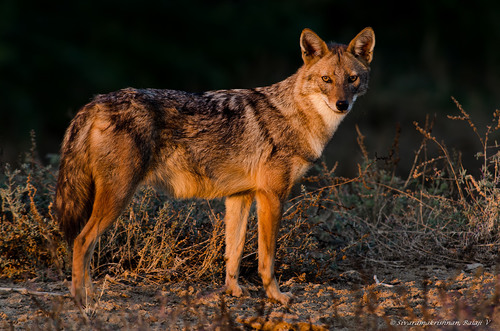
Golden Jackal
Canis aureus
A resilient and vocal opportunist, the Golden Jackal is currently staging one of the most successful wildlife expansions in history. Known for their golden winter coats and complex social lives, these adaptable canids are becoming a frequent sight on trail cameras across Eurasia.
Quick Identification
Size
Length of 70-105 cm (28-41 in) with a shoulder height of 45-50 cm (18-20 in); weight ranges from 6-15 kg (13-33 lbs)
Colors
Coat ranges from pale creamy yellow to golden-tan; winter coats are darker tawny beige with grizzled black and white hairs on the back; underparts are pale ginger to white.
Key Features
- Slender, wolf-like build with a narrow, pointed muzzle
- Short, bushy tail usually tipped with black
- Large, upright ears and a less prominent forehead than wolves
- Golden-to-tawny fur that changes density and hue with the seasons
When You’ll See Them
Geographic range
Where Does the Golden Jackal Live?
Native to the vast stretches of Eurasia, the golden jackal's ancestral heartland spans from North and East Africa through the Middle East and into the Indian Subcontinent. In recent decades, this resilient canid has undergone a massive natural expansion across Europe, moving from the Balkans into countries as far north as Estonia and as far west as France. Today, they are commonly found in high densities throughout India, Turkey, Bulgaria, and Romania, thriving in diverse landscapes where food is plentiful.
Basemap © OpenStreetMap contributors
Behavior
The golden jackal is a highly social and adaptable canid, most famous for its haunting, high-pitched yapping and howling. They are primarily monogamous, with pairs forming long-term bonds and often hunting together to take down larger prey. In many regions, they live in small family units consisting of a breeding pair and their offspring from previous years, who act as 'helpers' to raise the newest litter.
While they are naturally shy around humans, golden jackals are incredibly opportunistic and have learned to thrive on the fringes of civilization. They are active hunters but won't hesitate to scavenge from landfills or compost heaps. Their behavior is often dictated by human activity; in areas with high human presence, they become strictly nocturnal, while in quieter regions, they may be seen hunting during the day.
EverydayEarth exclusive
Camera Tips
To capture a golden jackal on your camera, focus on 'edge' habitats where domestic and wild spaces meet. They are fond of using established trails, dirt tracks, and the boundaries between forests and agricultural fields. Position your camera at knee height—approximately 45-50 cm off the ground—and angle it slightly downward to ensure you capture the legs and tail, which are vital for distinguishing them from foxes or wolves.
Jackals have a keen sense of smell and are naturally curious but cautious. Using a scent lure, such as fatty acid tablets or even a small amount of pungent canned fish hidden in a perforated container, can encourage them to linger in front of the lens. However, avoid leaving large amounts of open food, as this may attract unwanted domestic dogs or larger predators that might scare the jackals away.
Because they are most active during low-light hours, ensure your camera has a high-quality infrared (no-glow) flash. This prevents the animal from being spooked by a visible light or a red glow, which is important for capturing natural social behaviors. Set your camera to 'Burst Mode' or 'Hybrid Mode' (taking both a photo and a video) to capture their movement patterns and vocalizations, which are unique to the species.
Pay attention to the seasons. During the winter, their coats are much thicker and more photogenic, making for stunning captures. In late spring and early summer, you are more likely to record pups following their parents. If you find a potential den site, keep your camera at a respectful distance (at least 20-30 meters) to avoid disturbing the family, as jackals are known to move their pups if they feel watched.
Similar Species
Species that look similar or are commonly confused with Golden Jackal.
Red Fox
The fox is smaller with much shorter legs, a longer white-tipped tail, and black 'stockings' on its paws.
Gray Wolf
Wolves are significantly larger (30-50kg) with broader heads, shorter ears relative to head size, and a more robust muzzle.
Coyote
While they look similar, coyotes are native to North America and are generally larger with more varied coat patterns.
Frequently Asked Questions
Record Golden Jackal at your habitat
Connect a camera to start building your own species record — AI identifies every visitor automatically.