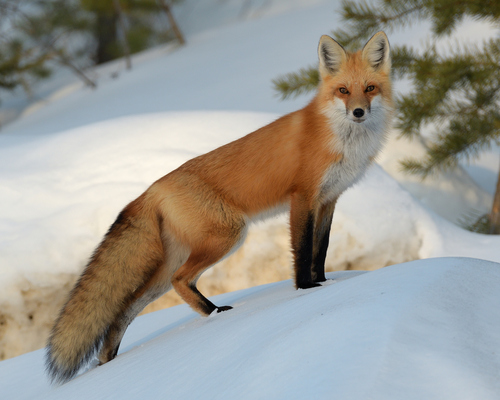
Red Fox
Vulpes vulpes
Master of the suburban shadows, the Red Fox is a brilliant display of adaptability and grace. With its iconic fiery coat and clever eyes, it is perhaps the most rewarding visitor to capture on a backyard camera.
Quick Identification
Size
Body length 45–90 cm (18–35 in); tail length 30–55 cm (12–22 in); weight 2.2–14 kg (5–31 lbs)
Colors
Rusty red-orange coat with a white chest, throat, and belly; distinctive black 'stockings' on the lower legs and black-tipped ears; tail always features a white tip.
Key Features
- Bushy tail with a prominent white tip
- Black 'socks' on the lower legs and feet
- Pointed muzzle with a white-furred underside
- Triangular black-backed ears
When You’ll See Them
Sightings on EverydayEarth
Mar 1, 2026
A Red Fox is seen squatting on a snow-covered trail at night, appearing to defecate or scent-mark. It then walks out of the frame toward the right.
Apr 29, 2026
A Red Fox is seen exploring the leaf-covered forest floor. It carefully sniffs around the base of a large fallen log and moves through the clearing, appearing to be foraging or investigating the area.
Jun 25, 2026
A Red Fox trots across the clearing under the cover of night, appearing to carry prey in its mouth. Its eyes reflect the infrared light as it moves from the center toward the right side of the frame.
Mar 29, 2026
A Red Fox trots into the lower-left corner of the frame, pausing briefly with its eyes reflecting the infrared light before turning and heading back the way it came. Much later in the footage, a large puff of condensation, likely from the fox's breath, drifts into the frame from the left edge.
Feb 28, 2026
A Red Fox is observed walking across a leaf-littered woodland trail at night. It enters from the right side of the frame and moves toward the left-background before disappearing into the darkness. The remainder of the video shows the static forest scene.
Mar 28, 2026
A Red Fox trots across the leaf-covered forest floor in the pre-dawn hours. Its distinctive bushy tail with a white tip is clearly visible as it moves steadily through the woods, pausing briefly to look around before continuing its path.
Behavior
Red Foxes are remarkably intelligent and resourceful survivors, often referred to as the 'cats of the dog world' due to their ability to climb trees, jump high fences, and hunt with feline-like stealth. While they are members of the canine family, they are solitary hunters that do not form packs, though they maintain complex social structures within a family unit. In suburban environments, they have become master 'ghosts,' living in close proximity to humans while remaining largely unseen, often denning under porches, sheds, or in quiet corners of overgrown gardens.
Their social behavior becomes most apparent during the winter mating season and spring pup-rearing months. You might hear their eerie, high-pitched 'vixen scream' during cold winter nights, a vocalization used to locate mates. Despite their predatory nature, they are generally shy and will avoid direct confrontation with humans and larger pets, preferring to use their keen senses of hearing and smell to navigate around obstacles and threats.
EverydayEarth exclusive
Camera Tips
To capture the perfect Red Fox shot, camera placement is everything. Foxes are 'edge' travelers, meaning they prefer to move along the boundaries where two habitats meet—think the line where your lawn meets the woods, or along a backyard fence. Position your camera about 12 to 18 inches off the ground. This height captures the fox at eye level, providing a much more intimate and professional-looking perspective than a steep downward angle from a tree trunk.
Scent is a more effective and responsible lure than large piles of food. If you want to stop a fox in its tracks for a clear photo, try a small smear of canned cat food or a dedicated 'gland lure' from a wildlife supply shop on a nearby log. Avoid leaving out large quantities of human food, which can habituate them to people or attract unwanted neighborhood pets. A small, smelly bait will encourage the fox to linger and sniff, giving your camera’s sensor time to trigger and focus.
Because foxes can be quite fast, especially when they get the 'zoomies' in the middle of the night, set your camera to a high-speed burst mode or, better yet, a 10-15 second video clip. Video allows you to capture their fascinating behaviors, like the 'mousing' jump where they leap high into the air to pounce on prey. Ensure your camera has a fast trigger speed (0.3 seconds or less) to avoid getting shots of just a disappearing white-tipped tail.
Seasonal timing can also dictate your success. In late winter (January-February), foxes are very active and vocal during the day as they seek mates. In late spring (May-June), if you are lucky enough to have a den nearby, you may capture the kits playing. During these times, ensure your PIR sensitivity is set to 'High' to catch the smaller, faster movements of the pups. Always check your background; a fox’s red coat pops beautifully against white snow or green grass, so try to frame your shot against a contrasting backdrop.
Similar Species
Species that look similar or are commonly confused with Red Fox.
Frequently Asked Questions
Record Red Fox at your habitat
Connect a camera to start building your own species record — AI identifies every visitor automatically.