Gray Fox
Urocyon cinereoargenteus
The only North American canid that can climb trees, the Gray Fox is a 'salt-and-pepper' ghost of the forest. Agile, elusive, and strikingly beautiful, this nocturnal acrobat is the ultimate prize for backyard wildlife observers.
Quick Identification
Size
76–112.5 cm (30–44 in) length; 3.6–7 kg (8–15 lb) weight
Colors
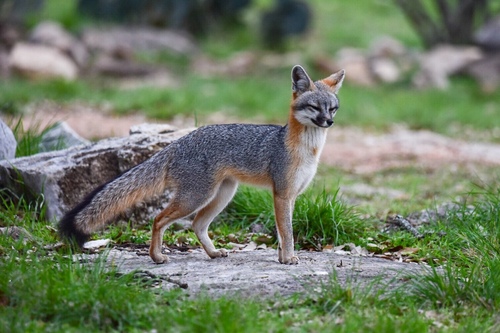
Grizzled salt-and-pepper gray back and sides; reddish-cinnamon fur on the neck, ears, and legs; white throat and belly; black stripe along the top of the tail.
Key Features
- Grizzled gray 'salt and pepper' coat
- Prominent black stripe along the top of the tail ending in a black tip
- Reddish-orange fur on the neck and legs
- Cat-like face with semi-retractable claws for climbing trees
- Smaller and stockier than a Red Fox
When You’ll See Them
Sightings on EverydayEarth
May 15, 2026
Under the cover of darkness, a Grey Fox explores a raised feeding platform. It pauses briefly to scan its surroundings, showing off its long, bushy tail and alert ears before moving across the structure.
Geographic range
Where Does the Gray Fox Live?
Native to the Americas, the Gray Fox is widely distributed from the southern border of Canada throughout the United States and Mexico, extending through Central America into the northernmost reaches of South America. It is a highly adaptable species found in diverse environments, though it is notably absent from the high mountains of the northwestern United States and the Great Plains. These foxes thrive particularly well in the eastern deciduous forests and the arid scrublands of the Southwest, where their climbing skills give them a distinct competitive advantage over other predators.
Basemap © OpenStreetMap contributors
Behavior
They are primarily solitary animals but are known to be monogamous, with pairs often staying together for several years. While they are mostly active during the night and twilight hours, they may be seen during the day in quiet, undisturbed areas. When threatened, they are more likely to head for the canopy or a dense thicket than to engage in a long-distance chase.
In suburban settings, Gray Foxes are remarkably adaptable but remain elusive. They often utilize 'hidden' corridors like overgrown fence lines or drainage culverts to move through neighborhoods undetected. Their vocalizations are varied, ranging from harsh barks and yips to high-pitched screams that can be quite startling when heard in the middle of the night.
EverydayEarth exclusive
Camera Tips
To capture a Gray Fox on your backyard camera, focus on the edges of your property where the 'wild' meets the 'maintained.' These foxes are masters of stealth and rarely cut across the middle of a manicured lawn. Look for natural funnels such as gaps in a hedge, fallen logs, or the base of large, leaning trees. Because they are the only canids that climb, a camera pointed at a large horizontal branch or a leaning oak trunk can yield spectacular, unique footage that you'd never get with a Red Fox or Coyote.
Set your camera at a relatively low height—about 12 to 15 inches off the ground—to get an eye-level perspective. If you are using a trail camera with adjustable PIR sensitivity, set it to 'High' to ensure you catch their quick, cat-like movements. Gray Foxes are generally more wary of white light than Red Foxes, so a 'No-Glow' or 'Black Flash' infrared camera is highly recommended to avoid spooking them and to ensure they return to the area frequently.
If you are struggling to get them to stop in front of the lens, natural lures can help. They are highly attracted to the scent of fallen fruit in the autumn, particularly persimmons or apples. In the winter, a small amount of fatty meat or even a sardine hidden under a rock can encourage them to linger long enough for a clear photo. However, be mindful that food lures may also attract neighborhood cats or raccoons. Often, just providing a clean water source like a ground-level birdbath is enough to make your yard a regular stop on their nightly patrol.
Similar Species
Species that look similar or are commonly confused with Gray Fox.
Red Fox
Lacks the black tail stripe of the Gray Fox and typically has white-tipped tail and black 'stockings' on its legs.
Coyote
Much larger than a Gray Fox with longer legs, a shorter tail relative to body size, and lacks the ability to climb trees.
Island Fox
A direct relative but much smaller, found only on the Channel Islands of California.
Frequently Asked Questions
Record Gray Fox at your habitat
Connect a camera to start building your own species record — AI identifies every visitor automatically.