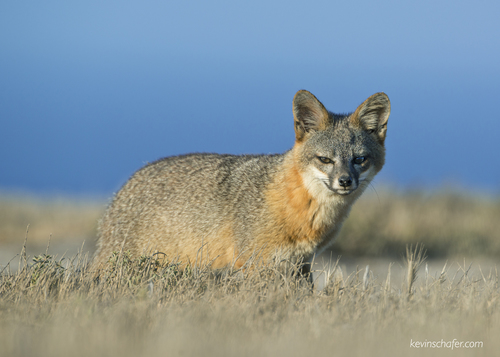
Island Fox
Urocyon littoralis
The Island Fox is North America’s smallest fox, a cat-sized treasure found only on the rugged Channel Islands of California. These fearless, cinnamon-hued explorers are a testament to the wonders of island evolution.
Quick Identification
Size
Head-and-body length of 48–50 cm (19–20 in) with a weight of 1.3–2.8 kg (2.8–6.2 lbs)
Colors
Grizzled salt-and-pepper gray on the back, cinnamon or rufous on the flanks and neck, and white on the throat and belly. The tail has a prominent black stripe on the top.
Key Features
- Diminutive size comparable to a house cat
- Grizzled gray fur with rusty-red highlights on the neck and sides
- Black-tipped tail with a dark dorsal stripe
- Distinctly docile and bold demeanor around humans
When You’ll See Them
Sightings on EverydayEarth
Apr 21, 2026
An island fox is seen foraging on a large stick nest perched on a rocky cliff. It moves cautiously across the debris, sniffing the ground in the darkness while its eyes occasionally reflect the camera's infrared light.
Geographic range
Where Does the Island Fox Live?
Native to North America, the Island Fox is found exclusively on six of the eight Channel Islands located off the coast of Southern California. This tiny geographic footprint makes them one of the most range-restricted carnivores in the world, with distinct subspecies living on San Miguel, Santa Rosa, Santa Cruz, San Nicolas, Santa Catalina, and San Clemente islands. Because they are restricted to these isolated landmasses, they have evolved separately from their mainland ancestors for over 7,000 years.
Basemap © OpenStreetMap contributors
Behavior
Island Foxes are remarkably bold compared to their mainland cousins, showing an unusual lack of fear toward humans. This trait stems from their evolution in an environment with no natural terrestrial predators for thousands of years. While they are primarily solitary, they are not strictly nocturnal; they exhibit 'cathemeral' behavior, meaning they are active at various times throughout the day and night to take advantage of available resources.
These foxes are highly territorial and use scent marking to define their boundaries. Interestingly, they are excellent climbers, much like the Gray Fox, and are frequently spotted in the branches of scrub oaks or atop large shrubs foraging for food. Socially, they form monogamous pairs that often stay together for life, raising a single litter of pups each spring in dens tucked away in rocky crevices or hollow logs.
EverydayEarth exclusive
Camera Tips
To capture the Island Fox, place your camera much lower than you would for a standard mainland fox. These are 'bonsai' foxes, so a mounting height of just 6 to 10 inches off the ground provides the best eye-level perspective. Because they are naturally curious and lack a fear response to new objects, they will often walk right up to a camera to sniff the lens. Using a wide-angle lens is highly recommended to capture their entire body at close range.
Focus your efforts on transition zones where scrubland meets open trails or beaches. They frequently use human-made hiking trails as 'highways' through dense chaparral. Since they are active during the day (diurnal) as well as at night, ensure your camera is set to 24-hour operation. They are particularly fond of the fruit from the prickly pear cactus and manzanita; placing a camera near these fruiting plants during the late summer can yield excellent results.
While food baiting is often discouraged or prohibited in their protected habitats, you can attract their curiosity using non-food olfactory lures like a small amount of fatty acid soap or even a rag soaked in valerian root. Because they are remarkably fast and agile, use a camera with a high trigger speed (0.2 seconds or faster) and a short recovery time to ensure you don't just catch a glimpse of a tail disappearing from the frame.
During the spring months (April-May), look for rocky outcrops or hollowed-out logs which may serve as dens. However, maintain a respectful distance with your camera placement to avoid disturbing the pups. Because the islands can be windy and dusty, use a protective housing and check your lens for salt spray if you are filming near the coast.
Similar Species
Species that look similar or are commonly confused with Island Fox.
Frequently Asked Questions
Record Island Fox at your habitat
Connect a camera to start building your own species record — AI identifies every visitor automatically.