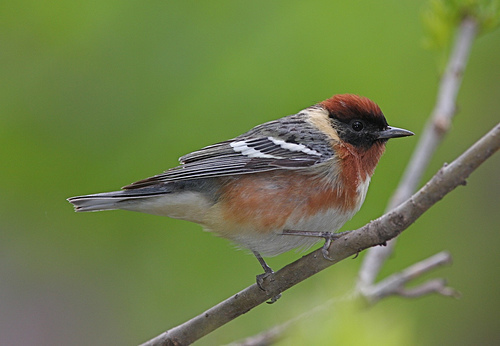
Bay-breasted Warbler
Setophaga castanea
A champion of the boreal forest, the Bay-breasted Warbler is a stunning long-distance traveler recognized by its deep chestnut plumage and its role as a natural pest controller during spruce budworm outbreaks.
Quick Identification
Size
Length: 12–14 cm (4.7–5.5 in); Wingspan: 20–22 cm (7.9–8.7 in); Weight: 10–15 g (0.35–0.53 oz)
Colors
Breeding males feature a deep chestnut (bay) crown, throat, and flanks, with a cream-colored patch on the side of the neck. Females and non-breeding birds are olive-green above with two white wing bars and varying amounts of bay wash on the flanks.
Key Features
- Distinctive chestnut-colored throat and sides in breeding males
- Creamy buff-colored patch on the side of the neck
- Two prominent white wing bars
- Relatively heavy bill compared to other Setophaga warblers
When You’ll See Them
Geographic range
Where Does the Bay-breasted Warbler Live?
The Bay-breasted Warbler is a native of North America, where it spends its summers breeding across a wide belt of the boreal forests stretching from eastern Canada through the Great Lakes region of the United States. As a long-distance migrant, this species travels through the eastern and central U.S. to reach its wintering grounds in Central America and the northern tip of South America. You will most commonly find them concentrated in the forests of Panama and Colombia during the northern winter months, where they thrive in lush, tropical environments.
Basemap © OpenStreetMap contributors
Behavior
The Bay-breasted Warbler is known for its relatively deliberate foraging style compared to its more hyperactive relatives. While many warblers flit rapidly between leaves, the Bay-breasted often moves slowly along inner branches, searching for large larvae and insects. During the breeding season, they are specialists of the boreal forest, often timing their population booms with outbreaks of the spruce budworm.
Socially, they are fairly solitary during the summer but will join mixed-species foraging flocks during migration and on their wintering grounds in the tropics. They are high-canopy birds for much of the year, making them a challenge to spot without binoculars. In your backyard, they are most likely to be seen briefly during the peak of spring or fall migration as they stop to refuel on insects and berries.
EverydayEarth exclusive
Camera Tips
Capturing a Bay-breasted Warbler on camera is a rewarding challenge because they spend so much time in the high canopy. To bring them down to camera level, focus entirely on water. A birdbath with a moving water feature, such as a dripper or a solar-powered fountain, is the single most effective way to attract this species during their migration window. Place your camera 3 to 5 feet away from the water source, ideally at a low angle to capture the reflection and the intricate bay-colored plumage.
Because these birds move through quickly during migration, timing is everything. In the northern U.S., set your cameras for 'burst mode' or high-frame-rate video during the second or third week of May and again in mid-September. Since they are small and fast, a shutter speed of at least 1/1000th of a second is necessary to freeze the motion of their wings during a bath. Position the camera so the sun is behind it, as the deep chestnut colors of the male require good lighting to truly pop in the frame.
If you have tall conifers like spruce or fir in your yard, consider mounting a camera on a high branch facing a horizontal limb. Bay-breasted Warblers are known to 'creep' along branches more than other warblers, providing a slightly better window of opportunity for a clear shot. Use a PIR (Passive Infrared) sensor with high sensitivity settings, as these lightweight birds might not always trigger lower-end motion sensors. Avoid using birdseed as a lure; instead, plant native berry-producing shrubs like serviceberry or dogwood to provide a natural foraging backdrop for your trail cam.
Similar Species
Species that look similar or are commonly confused with Bay-breasted Warbler.
Frequently Asked Questions
Record Bay-breasted Warbler at your habitat
Connect a camera to start building your own species record — AI identifies every visitor automatically.