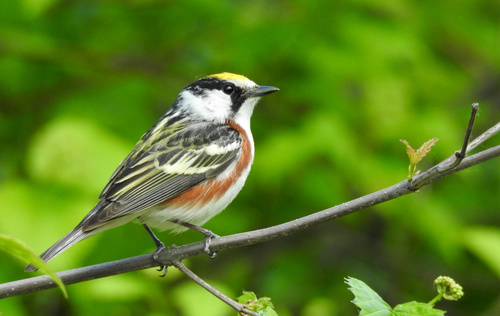
Chestnut-sided Warbler
Setophaga pensylvanica
A vibrant gem of the shrublands, the Chestnut-sided Warbler is easily recognized by its golden crown and rich reddish-brown flanks. This acrobatic insect-hunter is a favorite of backyard birders who enjoy the 'messier' side of nature.
Quick Identification
Size
Length: 10–14 cm (4–5.5 in); Wingspan: 19–21 cm (7.5–8.3 in); Weight: 8–13 g (0.3–0.5 oz)
Colors
Bright yellow crown, white face and underparts, black 'mustache' stripe, and distinctive chestnut-colored streaks along the flanks. Back is lime-green with black streaks.
Key Features
- Bright yellow crown
- Bold chestnut-brown streaks along the sides
- White cheeks and throat
- Two yellowish-white wing bars
- Habit of holding its tail cocked upward
When You’ll See Them
Geographic range
Where Does the Chestnut-sided Warbler Live?
Native to North America, the Chestnut-sided Warbler primarily breeds in the eastern United States and across southern Canada, from the Maritimes to the edge of the prairies. They are particularly concentrated around the Great Lakes and the Appalachian Mountains. As a long-distance neotropical migrant, they travel south each autumn to winter in Central America, specifically from southern Mexico down to Panama.
Basemap © OpenStreetMap contributors
Behavior
The Chestnut-sided Warbler is an incredibly energetic and inquisitive bird, often seen hopping through the mid-to-lower levels of deciduous trees and shrubs. Unlike many other warblers that skulk in deep foliage, this species is relatively easy to observe as it flits between branches, frequently cocking its tail like a wren. During the breeding season, males are famous for their high-pitched, musical song, often transcribed as 'Please-please-please-to-meet-cha,' which they use to defend their shrubby territories.
These birds are primarily solitary during the nesting season but become more social during migration and on their wintering grounds in Central America. In the tropics, they frequently join mixed-species foraging flocks, following 'resident' birds to find food. While they are not overly shy around humans, they require specific 'messy' habitat—like overgrown fields or forest edges—to feel secure in a backyard setting.
EverydayEarth exclusive
Camera Tips
To capture the Chestnut-sided Warbler on camera, focus on 'edge' habitats rather than the middle of a manicured lawn. Position your AI camera near the transition zone where tall grass or shrubs meet the forest. These birds are low-level foragers, so mounting your camera between 3 and 5 feet off the ground is ideal. Angle the lens slightly downward toward a perch or a dense thicket of native shrubs like blackberry, elderberry, or young maple saplings.
While they won't visit standard bird feeders, water is an irresistible lure. A shallow birdbath with a solar-powered dripper or a small waterfall feature is the most effective way to attract them to a specific spot for a photo. The movement and sound of dripping water are key; these birds are drawn to the sound of moving water during their high-energy migration journeys.
Lighting is critical for showing off their yellow crown and chestnut streaks. Choose a spot that receives dappled morning sunlight. Because they move very quickly, set your camera to its highest trigger speed or 'burst mode.' In the spring (May), focus your efforts on areas where you hear their distinctive 'Please-to-meet-cha' song, as males will frequently return to the same prominent song perches.
Similar Species
Species that look similar or are commonly confused with Chestnut-sided Warbler.
Frequently Asked Questions
Record Chestnut-sided Warbler at your habitat
Connect a camera to start building your own species record — AI identifies every visitor automatically.