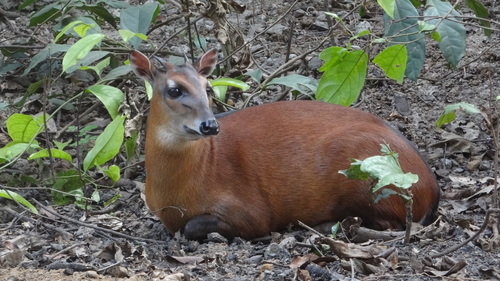
Bay Duiker
Cephalophus dorsalis
A secretive inhabitant of the African rainforest, the Bay Duiker is easily recognized by the bold black stripe that races down its reddish-brown back. Though rarely seen by day, this nocturnal specialist is a master of navigating the shadows of the jungle floor.
Quick Identification
Size
Shoulder height of 44–49 cm (17–19 in); weight typically ranging from 18–23 kg (40–51 lb)
Colors
Rich reddish-brown coat with a signature thick, solid black stripe running from the head to the tip of the tail
Key Features
- Prominent black dorsal stripe
- Short, spiky horns on both sexes (5-8 cm)
- Arched back with a low-slung head
- Large, dark eyes specialized for night vision
When You’ll See Them
Geographic range
Where Does the Bay Duiker Live?
Native to the vast tropical forest belt of Africa, the Bay Duiker thrives within the humid equatorial regions of the continent. Its core population is centered in the Congo Basin, stretching across nations such as Gabon, Cameroon, the Republic of the Congo, and the Democratic Republic of the Congo. It is also found in the Upper Guinean forests of West Africa, including Ivory Coast, Ghana, and Liberia, though these populations are increasingly fragmented by habitat loss.
Basemap © OpenStreetMap contributors
Behavior
The Bay Duiker is a famously secretive and solitary mammal, distinguished from many of its relatives by its strictly nocturnal lifestyle. During the daylight hours, it retreats into the deepest shadows of the rainforest, often bedding down in hollow logs, under fallen trees, or within dense root buttresses to avoid predators. Because they are so elusive, seeing one in the wild is a rare treat for even the most seasoned wildlife observers.
These small antelopes are highly territorial and rely on a keen sense of smell to navigate their environment and communicate with other duikers. They possess large preorbital glands under their eyes which they use to scent-mark twigs and leaves, defining the boundaries of their home range. While generally shy, they are known to be quite alert, using their acute hearing to detect the slightest rustle of a predator approaching through the leaf litter.
EverydayEarth exclusive
Camera Tips
To capture the Bay Duiker on camera, you must focus on the night shift. Because they are strictly nocturnal, a camera with high-quality infrared (IR) LEDs is essential. Specifically, look for 'No-Glow' or 'Black Flash' models; these duikers are extremely skittish, and the faint red glow from standard IR cameras can spook them, causing them to bolt before you get a clear shot of that famous dorsal stripe.
Placement is everything for this low-profile mammal. Position your camera about 12 to 18 inches off the ground, roughly at 'knee height' for a human. This angle ensures you capture the side profile and the back of the animal, which are necessary for identifying the black stripe. Aim the camera along established game trails or near the base of large fruiting trees—specifically Ficus species—as these are natural magnets for foraging duikers.
If you are monitoring a private wooded area in their native range, a small salt lick or a handful of fallen fruit can act as a gentle lure to slow them down in front of the lens. Use a fast trigger speed (0.3 seconds or less) and set your camera to take a 'burst' of 3-5 photos or a short 10-second video clip. This increases your chances of getting a sharp image as they move quickly through the undergrowth. Since they live in high-humidity rainforests, always use fresh lithium batteries and a desiccant pack inside the camera housing to prevent lens fogging.
Similar Species
Species that look similar or are commonly confused with Bay Duiker.
Frequently Asked Questions
Record Bay Duiker at your habitat
Connect a camera to start building your own species record — AI identifies every visitor automatically.