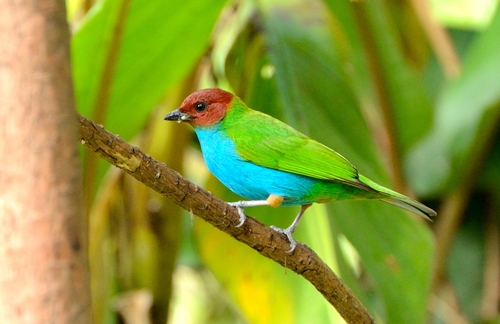
Bay-headed Tanager
Tangara gyrola
A crown of chestnut and a coat of emerald and turquoise make the Bay-headed Tanager one of the most stunning visitors to Central and South American forest edges. This social bird is a master of the canopy, bringing vibrant life to mixed-species flocks.
Quick Identification
Size
13.5–14.5 cm (5.3–5.7 in) in length; 18–25 g (0.6–0.9 oz) in weight
Colors
Distinctive chestnut-red head, bright green upperparts, turquoise-blue underparts, and a narrow yellow collar on the nape.
Key Features
- Rich chestnut-brown head
- Thin golden-yellow band on the back of the neck
- Vibrant turquoise or sky-blue belly
- Bright leaf-green wings and tail
When You’ll See Them
Geographic range
Where Does the Bay-headed Tanager Live?
This spectacular bird is native to the lush tropical regions of Central and South America. Its range begins in southern Costa Rica and Panama, extending through the northern Andes into Colombia, Venezuela, and the island of Trinidad. Southward, it is widely distributed across the Amazon basin, found in the humid lowlands and foothills of Ecuador, Peru, Bolivia, and northwestern Brazil. It is a highly adaptable species within its tropical belt, thriving wherever mature trees provide sufficient fruit and cover.
Basemap © OpenStreetMap contributors
Behavior
The Bay-headed Tanager is a quintessential social bird of the Neotropics, almost always seen in pairs or as part of a larger, mixed-species foraging flock. These flocks are a marvel of biodiversity, often including other tanager species, honeycreepers, and wood-warblers moving through the canopy in a coordinated search for food. They are energetic and acrobatic, frequently seen leaning at extreme angles or even hanging upside down to reach small berries on the ends of thin twigs.
While they primarily occupy the middle to upper levels of the forest, they are not shy about venturing lower if a particularly enticing fruiting tree or bird feeder is available. Their presence is often signaled by their vocalizations—a series of high-pitched, thin 'tsip' calls. Unlike some of their more territorial cousins, Bay-headed Tanagers are generally peaceful, focusing their energy on foraging and maintaining social bonds within their small groups.
EverydayEarth exclusive
Camera Tips
To successfully capture the Bay-headed Tanager on camera, height is your greatest ally. These birds are canopy specialists and rarely descend to the ground. For the best results, mount your AI-powered camera on a branch at least 6 to 10 feet high, overlooking a platform feeder or a natural branch where you can secure bait. Angle the camera slightly downward to capture the contrast between the chestnut head and the turquoise belly.
Fruit is the ultimate lure for this species. They are particularly fond of overripe bananas, plantains, and halved papayas. To prevent larger birds or mammals from dragging the fruit away, use a small spike or wire to fix the fruit to a sturdy branch within the camera's focal range. If you have a birdbath, placing it on a pedestal in a sun-dappled area can also attract them, as they enjoy frequent bathing in the tropical heat.
Lighting is critical for identifying this species accurately. Try to position your setup so that the early morning sun illuminates the feeding station. The iridescent green and blue feathers can look dark and muted in heavy shade, but they 'pop' with incredible vibrance in direct or filtered sunlight. Set your camera's motion sensitivity to high, as tanagers are quick, nervous flyers that may only land for a few seconds at a time.
Finally, keep your camera active throughout the morning. Bay-headed Tanagers often follow a 'traplining' foraging route, meaning they visit the same fruiting trees at roughly the same time each day. If you catch them once at 8:00 AM, there is a very high probability they will return the following morning at a similar time.
Similar Species
Species that look similar or are commonly confused with Bay-headed Tanager.
Blue-necked Tanager
The Blue-necked Tanager has a bright blue head and a black mask, whereas the Bay-headed has a reddish-brown head and no mask.
Silver-throated Tanager
The Silver-throated Tanager is primarily bright yellow with a white throat, lacking the chestnut head and blue belly of the Bay-headed.
Frequently Asked Questions
Record Bay-headed Tanager at your habitat
Connect a camera to start building your own species record — AI identifies every visitor automatically.