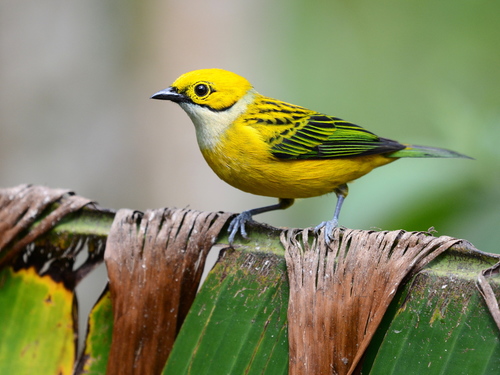
Silver-throated Tanager
Tangara icterocephala
A flash of living sunshine in the mossy cloud forests, the Silver-throated Tanager is a social gem known for its brilliant yellow coat and unique silvery bib.
Quick Identification
Size
Length: 13 cm (5.1 in); Wingspan: approx. 20-23 cm (8-9 in); Weight: 22 g (0.78 oz)
Colors
Bright canary-yellow body with a distinct silvery-white throat; black streaking on the back; wings and tail are black with vibrant lime-green edges. Females are slightly duller and greener.
Key Features
- Distinctive silvery-white throat patch
- Thin black line separating the white throat from the yellow cheeks
- Bright yellow plumage with black-streaked mantle
- Lime-green edging on wing and tail feathers
When You’ll See Them
Behavior
The Silver-throated Tanager is a high-energy bird often found moving through the mid-canopy and forest edges. They are highly social and are rarely seen alone, typically traveling in pairs or small family groups. They are a staple member of mixed-species foraging flocks, often seen moving alongside honeycreepers, wood-warblers, and other tanagers as they traverse the forest in search of food.
These birds are known for their restless nature, constantly hopping and fluttering between branches. While they spend much of their time high up in the trees, they are quite bold and will descend to lower levels for a ripening fruit crop or a well-placed backyard feeder. Their vocalizations are thin, high-pitched 'tsip' calls that help keep the group together as they move through dense foliage.
EverydayEarth exclusive
Camera Tips
To capture the brilliant yellow of the Silver-throated Tanager, camera placement is everything. These birds are canopy-dwellers by nature but are easily lured to lower levels with fruit. Mounting your AI camera near a platform feeder stocked with halved bananas or papayas is the most effective strategy. Aim to place the camera 5 to 7 feet off the ground, ideally within a few feet of a 'perch' branch where the bird can land and survey the area before hopping onto the feeder.
Lighting is your biggest challenge in their typical mossy, overcast forest habitats. Position your camera so it faces away from the morning sun to avoid backlighting, which can turn this bird’s vibrant yellow into a dark silhouette. The 'Golden Hour' shortly after sunrise is the best time for photography, as the warm light emphasizes the metallic sheen of their white throat and the lime-green highlights in their wings. If your camera has adjustable exposure settings, a slight underexposure can help prevent the bright yellow feathers from 'blowing out' in direct sunlight.
Because they are fast-moving and prone to sudden twitches, set your camera to a high trigger speed or a multi-shot burst mode. This increases the likelihood of catching them in a still pose or with their wings partially fanned, revealing the intricate black and green patterns. If you are using a trail camera in a more natural forest setting, look for trees covered in moss and epiphytes near a water source; these birds often visit mossy limbs to pick out small insects, providing a more candid, 'wild' shot than a feeder setup.
Similar Species
Species that look similar or are commonly confused with Silver-throated Tanager.
Frequently Asked Questions
Record Silver-throated Tanager at your habitat
Connect a camera to start building your own species record — AI identifies every visitor automatically.