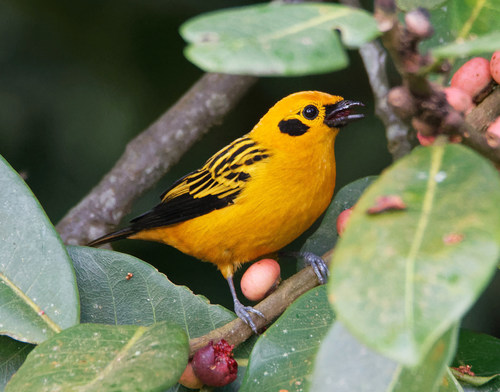
Golden Tanager
Tangara arthus
A shimmering jewel of the Andean cloud forests, the Golden Tanager illuminates the canopy with its brilliant sun-colored plumage and energetic social life. These stunning birds are the highlight of any high-altitude birding expedition or backyard camera setup in the South American highlands.
Quick Identification
Size
Length 13–14 cm (5.1–5.5 inches); Weight 18–25 grams (0.6–0.9 oz)
Colors
Brilliant golden-yellow body; distinct black ear patch; black wings and tail with greenish-yellow feather edges; upper back has black longitudinal streaks.
Key Features
- Luminous golden-yellow plumage across head and underparts
- Prominent black triangular patch on the ear-coverts
- Black streaking on the mantle and back
- Small, stout conical bill
- Bright yellow wing bars or feather edging
When You’ll See Them
Geographic range
Where Does the Golden Tanager Live?
Native to the lush highland corridors of South America, the Golden Tanager is a quintessential Andean species. Its range stretches from the Coastal Range of Venezuela through the subtropical zones of Colombia, Ecuador, and Peru, reaching its southern limit in the yungas of Bolivia. These birds are almost exclusively found in montane environments, thriving in the narrow altitudinal bands where temperate and tropical conditions meet.
Basemap © OpenStreetMap contributors
Behavior
Golden Tanagers are highly social and energetic birds, often found moving in small family groups or as core members of mixed-species foraging flocks. They are known for their constant movement, hopping through the canopy and mid-story levels of the forest in search of food. While they are not particularly shy, they prefer the cover of dense foliage, making their bright yellow feathers a useful beacon for observers in the misty highlands.
In terms of social interaction, these tanagers are rarely seen alone. They frequently associate with other Tangara species and wood-warblers. Their vocalizations are typically thin, high-pitched "tsip" calls that help maintain group cohesion as they travel through the forest. While they aren't aggressive toward humans, they are most comfortable in areas with significant vertical vegetation and overhead cover.
EverydayEarth exclusive
Camera Tips
To capture the Golden Tanager on camera, focus on high-vantage points or mid-story branches near fruit-bearing trees. Since these birds rarely descend to the ground, mounting your AI camera 3 to 5 meters high on a sturdy trunk, angled slightly downward toward a known foraging perch, is ideal. Look for Melastomataceae shrubs or Ficus trees, which act as natural magnets for this species. Using a solar-powered camera is highly recommended given the shaded, humid forest environments they inhabit.
While baiting with birdseed is ineffective for tanagers, a well-placed fruit platform can yield spectacular results. Offering overripe bananas or halved oranges is the most reliable way to lure them into the camera's field of view. Position the fruit on a natural-looking branch or a wooden platform that blends into the environment to encourage "natural" behavior shots rather than staged-looking photos. Ensure the camera's trigger speed is set to its fastest setting, as these birds are incredibly fast and rarely sit still for more than a few seconds.
Lighting is your biggest challenge in the dense cloud forests where the Golden Tanager lives. If possible, place your camera where dappled sunlight hits a specific branch during the morning hours. The brilliant yellow plumage can easily "blow out" (become a featureless white blob) in direct, harsh sun, so a spot with soft, filtered light will better capture the rich golden textures and the contrasting black ear patch. Set your AI camera to prioritize high-speed bursts to capture the perfect mid-hop frame.
Similar Species
Species that look similar or are commonly confused with Golden Tanager.
Frequently Asked Questions
Record Golden Tanager at your habitat
Connect a camera to start building your own species record — AI identifies every visitor automatically.