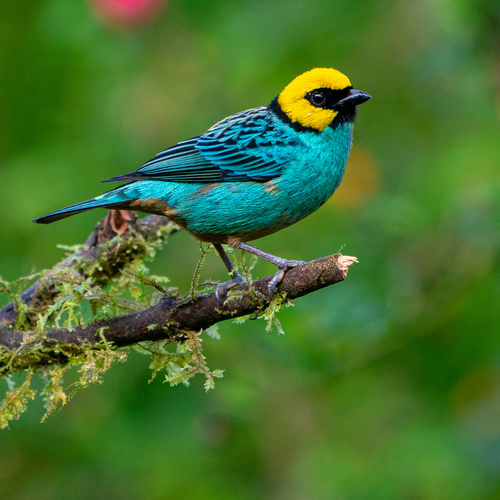
Saffron-crowned Tanager
Tangara xanthocephala
A social icon of the Andean cloud forests, the Saffron-crowned Tanager dazzles with its golden head and shimmering turquoise feathers. Watch for these acrobatic foragers as they move in vibrant, high-altitude flocks through the misty canopy.
Quick Identification
Size
Length of 13 cm (5.1 in); Weight range of 17–24 g (0.6–0.8 oz)
Colors
Brilliant saffron-yellow head and nape; iridescent blue-green body; black mask around eyes, forehead, and chin. Sexes appear similar.
Key Features
- Vivid golden-yellow head with a distinct black 'mask' and chin
- Shimmering turquoise to blue-green plumage on the back and belly
- Black primary wing feathers and tail edged with green
- High-altitude specialist often seen in mixed-species flocks
When You’ll See Them
Geographic range
Where Does the Saffron-crowned Tanager Live?
The Saffron-crowned Tanager is a jewel of the South American highlands, strictly native to the rugged slopes of the northern and central Andes. Its range forms a narrow, vertical corridor stretching from the coastal mountains of Venezuela through Colombia, Ecuador, and Peru, finally reaching its southern limit in the yungas of Bolivia. This species is a dedicated mountain dweller, thriving in the moisture-rich, misty environments where the forest meets the clouds.
Basemap © OpenStreetMap contributors
Behavior
The Saffron-crowned Tanager is a highly social and energetic bird, rarely found alone. It is a quintessential member of high-altitude 'party flocks,' often seen moving through the canopy in groups of three to ten individuals. These groups frequently join larger, mixed-species foraging flocks that include other tanagers, flowerpiercers, and woodcreepers, creating a fast-moving parade of color through the misty cloud forest.
In the wild, these birds are restless foragers. They are known for their acrobatic feeding style, often hanging upside down to reach berries on the undersides of branches or probing deeply into moss and epiphytes for hidden insects. While they primarily stay in the upper levels of the forest, they are relatively bold and will descend to lower levels or garden feeders if tempted by ripe fruit, showing a surprising level of tolerance for human presence in Andean mountain towns.
EverydayEarth exclusive
Camera Tips
To capture high-quality images of the Saffron-crowned Tanager, placement is everything. These birds are canopy-dwellers that occasionally dip into the mid-story. Set your AI-powered camera at an elevation of 5 to 9 feet, ideally overlooking a moss-covered branch or a platform feeder. Because they love the humidity of the cloud forest, placing your camera near a source of clean, moving water—like an elevated birdbath or a dripper—can be a magnet for them.
Baiting is highly effective for this species. They are particularly fond of soft, ripe fruits; skewering a half-peeled banana or a slice of papaya to a branch within the camera's focal range is a proven method to keep them stationary long enough for a clear shot. Since they travel in groups, use a camera setting with a high burst rate (3-5 photos per trigger) to capture the social dynamics of the flock.
Lighting in the cloud forest can be tricky and often dim. Position your camera to take advantage of early morning light, between 7:00 AM and 9:00 AM, when the birds are most active. If your camera allows for shutter speed adjustments, keep it fast (at least 1/1000s) to freeze their rapid, hopping movements. Lastly, ensure your equipment is well-protected with a rain shield or waterproof housing, as their habitat is characterized by near-constant mist and sudden downpours.
Similar Species
Species that look similar or are commonly confused with Saffron-crowned Tanager.
Flame-faced Tanager
Features a fiery red or orange face and a yellow crown, whereas the Saffron-crowned has a purely yellow head and black chin.
Golden Tanager
Has a mostly golden-yellow body and black wings, lacking the distinct blue-green body plumage of the Saffron-crowned.
Golden-eared Tanager
Has a primarily black head with a small golden patch behind the eye, compared to the fully yellow crown of the Saffron-crowned.
Frequently Asked Questions
Record Saffron-crowned Tanager at your habitat
Connect a camera to start building your own species record — AI identifies every visitor automatically.