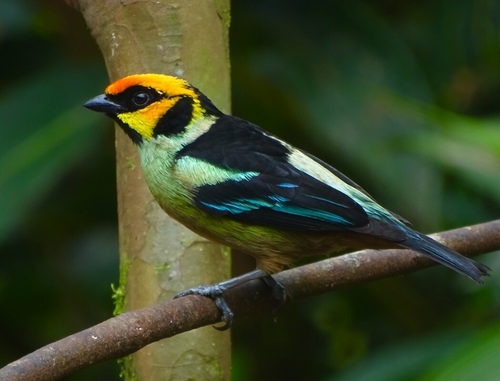
Flame-faced Tanager
Birds Active during the day

Flame-faced Tanager

Tangara parzudakii

With a face like a glowing ember and wings that shimmer like green opals, the Flame-faced Tanager is one of the Andes' most spectacular residents. This social bird brings a burst of fiery color to the mist-shrouded cloud forests of South America.

0 Sightings
0 Habitats

Quick Identification

straighten

Size

14–15 cm (5.5–5.9 inches) in length; weighs approximately 23–29 grams (0.8–1.0 oz)

palette

Colors

Striking red and yellow face mask, black mantle and wings with opalescent green edges, and buff-green underparts. Males and females look very similar.

visibility

Key Features

  • Fiery red and yellow facial mask
  • Opalescent silvery-green wing coverts
  • Black mantle and throat
  • Compact, medium-sized tanager silhouette
add_a_photo
Is this a Flame-faced Tanager?

Drop a photo or video to find out instantly

When You’ll See Them

schedule
Activity pattern Active during the day
brightness_5
Peak hours 6:30 AM - 10:30 AM
calendar_month
Season Year-round
restaurant
Diet A mix of fruit and insects. They specialize in small berries, especially those from the Melastomataceae family, but also glean spiders and larvae from the undersides of leaves.
park
Habitat Humid montane forests, cloud forests, and forest edges, often venturing into adjacent gardens and secondary growth.

public Geographic range

Where Does the Flame-faced Tanager Live?

This vibrant bird is a jewel of the South American Andes, found primarily in the lush, high-altitude regions of the continent. Its native range spans the eastern slopes of the mountain chain through Venezuela, Colombia, Ecuador, and Peru, with certain subspecies also appearing on the western slopes. It thrives in the mist-shrouded cloud forests where humidity is high and fruit is abundant year-round.

Basemap © OpenStreetMap contributors

4 Countries
2.1M km² Range
Least Concern Conservation
CO Colombia
Marginal
EC Ecuador
Marginal
PE Peru
Marginal
VE Venezuela
Marginal
Elevation range
0 m1,000 m2,000 m4,000 m
1,000 m – 2,600 m
eco
iNaturalist / Verified observation data
View on iNaturalist open_in_new

Explore more Birds arrow_forward

Behavior

The Flame-faced Tanager is a high-energy socialite of the Andean canopy. It is almost never found alone, typically moving in small groups of its own kind or joining large, mixed-species foraging flocks that travel through the forest looking for food. They are acrobatic feeders, often seen clinging upside down to reach ripe berries or darting quickly between mossy branches to snatch up small insects.

While they are primarily forest dwellers, they are surprisingly bold and will readily visit bird feeders at eco-lodges or forest-edge homes. Their presence is often heralded by high-pitched, thin 'tsip' calls that help the flock stay coordinated as they navigate the dense foliage. They are not migratory and will defend a territory year-round if food sources like fruiting trees are consistent.

photo_camera EverydayEarth exclusive

Camera Tips

To successfully film a Flame-faced Tanager, you must think vertically. These birds rarely descend to the forest floor, so mounting your AI camera at eye level or higher is essential. If you have a second-story balcony or can safely secure a camera to a tree limb 10–15 feet off the ground overlooking a clearing, you will have much better luck than with a standard tripod setup.

The best bait for these birds is fruit. A platform feeder stocked with overripe bananas, plantains, or halved papayas is nearly irresistible to them. Place the camera about 4 to 6 feet from the feeder to capture the intricate details of their 'flame' face. Because they are fast and twitchy, use a camera with a fast trigger speed and set it to take short video clips or high-speed bursts to ensure you catch them in a still moment while they are eating.

Water is another great lure, but it must be elevated. A hanging birdbath or a basin placed on a high pedestal will attract them for their morning preening sessions. Ensure your camera is positioned to avoid direct backlight from the rising sun, as the opalescent green in their feathers can 'wash out' or look black if the lighting isn't coming from behind the camera. Early morning between 7:00 AM and 9:00 AM is the 'golden hour' for this species, as they are most active before the midday heat sets in.

Frequently Asked Questions

Flame-faced Tanagers are most active in the early morning, typically from sunrise until about 10:00 AM. This is when they join mixed-species flocks to forage for fruit and insects before the mountain mists get too heavy or the afternoon sun peaks.
If you live within their Andean range, the best way to attract them is by providing fruit. Bananas and plantains are their favorites. Additionally, planting native fruiting shrubs like those from the Melastomataceae family will provide a natural and consistent food source that they prefer over feeders.
Their diet is primarily frugivorous, meaning they eat mostly fruit and berries. However, they are also opportunistic insectivores, gleaning small spiders, beetles, and caterpillars from the moss and leaves of canopy trees.
They are common in suburban areas only if those areas are located at high altitudes (1,000m+) and are adjacent to montane forests. They are frequent visitors to gardens in mountain towns that have plenty of trees and fruit-bearing plants.
Look specifically at the face. The Flame-faced Tanager has a unique two-toned mask of deep red and bright yellow. Similar birds like the Saffron-crowned Tanager have more uniform yellow on the head and lack the specific red cheek patch of the Flame-faced.

Record Flame-faced Tanager at your habitat

Connect a camera to start building your own species record — AI identifies every visitor automatically.

Join free Identify a photo