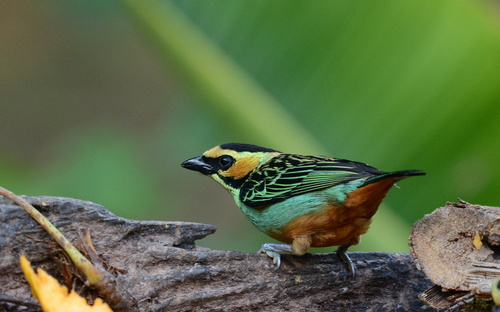
Golden-eared Tanager
Tangara chrysotis
With its shimmering emerald plumage and distinctive 'golden ears,' this Andean gem is a highlight for any birdwatcher. Thriving in the misty cloud forests, the Golden-eared Tanager brings a splash of brilliance to the lush South American canopy.
Quick Identification
Size
13–14 cm (5.1–5.5 inches) long; weight approx. 17–20 grams (0.6–0.7 oz)
Colors
Emerald green body with black 'scaly' markings; brilliant golden-orange ear patches; buffy or golden crown; black mask around eyes
Key Features
- Distinctive golden-orange patch on the ear coverts
- Emerald green plumage with black scalloped edges
- Buff-colored crown contrasting with a black facial mask
- Small, active bird often found in mixed-species flocks
When You’ll See Them
Geographic range
Where Does the Golden-eared Tanager Live?
This stunning tanager is native to the lush eastern slopes of the Andes Mountains in South America. Its range forms a narrow, vertical corridor of high-elevation habitat stretching from southern Colombia and eastern Ecuador through Peru and into western Bolivia. Within this montane belt, it thrives in moisture-rich environments where the cloud forest provides a constant supply of fruit and insects.
Basemap © OpenStreetMap contributors
Behavior
The Golden-eared Tanager is a high-energy acrobat of the Andean cloud forests. It is rarely seen sitting still for long, as it spends most of its daylight hours hopping through the canopy and mid-story in search of food. While they can be found in pairs or small family groups, they are most frequently observed as part of larger mixed-species foraging flocks, traveling alongside other tanagers, flowerpiercers, and woodcreepers to increase their chances of finding food and spotting predators.
These birds are not particularly shy, but their preference for the high forest canopy makes them a challenge to observe without binoculars. They interact with human-inhabited areas mostly at forest edges or where fruit-bearing trees are located near eco-lodges. Their social nature means that if you spot one Golden-eared Tanager, there are likely several other species of colorful tropical birds nearby, making them an 'indicator species' for high-diversity birding spots.
EverydayEarth exclusive
Camera Tips
To capture the Golden-eared Tanager on camera, height is your biggest challenge and greatest ally. Because these birds prefer the mid-story and canopy, mounting your camera 10 to 15 feet up in a tree—ideally overlooking a fruiting Melastome bush or a Cecropia tree—is much more effective than ground-level placement. Use a climbing strap or a specialized tree mount to angle the camera slightly downward toward a branch where the bird is likely to perch before feeding.
Baiting with native fruits is highly effective if you have a private forest-edge property or a garden near their natural habitat. Overripe bananas or local berries placed on a high 'feeding platform' (a flat wooden board secured to a branch) will draw them in. Ensure the platform is in a spot that receives dappled sunlight; tanagers' iridescent feathers look best in natural light, but harsh, direct midday sun can blow out the brilliant gold of their ear patches. Set your camera to a fast trigger speed and burst mode, as these birds move with rapid, jittery motions.
Since they are most active in the early morning, ensure your camera's ISO settings are optimized for low-light conditions to avoid grainy 'ghost' images during the dawn chorus. If your camera has a 'Time Lapse' mode, consider setting it for 1-minute intervals during the peak morning hours (6:00 AM to 9:00 AM) to capture them as they move through the canopy with mixed flocks, as they may not always trigger a PIR sensor if they are moving rapidly between branches.
Similar Species
Species that look similar or are commonly confused with Golden-eared Tanager.
Frequently Asked Questions
Record Golden-eared Tanager at your habitat
Connect a camera to start building your own species record — AI identifies every visitor automatically.