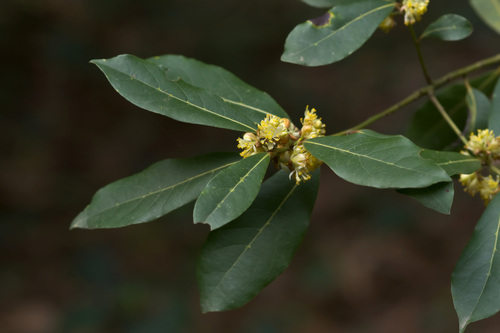
Bay laurel
Laurus nobilis
The ancient and aromatic Bay laurel is more than just a kitchen staple; it is a Mediterranean masterpiece that provides year-round sanctuary for songbirds and a feast for early-season pollinators.
Quick Identification
Size
Typically 7–18 metres (23–60 feet) tall with a canopy spread of 4–10 metres (13–33 feet).
Colors
Deep glossy green leaves, smooth grey bark, pale yellow-green flowers, and small black drupes (berries).
Key Features
- Glossy, lance-shaped aromatic leaves
- Smooth, grey bark that becomes finely fissured with age
- Small, four-lobed yellowish flowers in spring
- Oval black berries appearing in autumn on female trees
When You’ll See Them
Geographic range
Where Does the Bay laurel Live?
The Bay laurel is native to the sun-drenched Mediterranean Basin, spanning Southern Europe, North Africa, and Western Asia. It is most frequently found in the wild across Greece, Turkey, Italy, and Spain, where it thrives in humid coastal air and rocky hillsides. Due to its cultural and culinary importance, it has been widely introduced and naturalized in other regions with mild climates, such as the United Kingdom, the Pacific coast of the United States, and parts of Australia.
Basemap © OpenStreetMap contributors
Behavior
The Bay laurel is a slow-growing evergreen tree that has been a symbol of wisdom and victory since antiquity. In its natural Mediterranean habitat, it often grows as a multi-stemmed shrub, but under cultivation, it can be trained into a stately single-trunk tree or dense topiary. It is remarkably resilient, often living for over a century and capable of regenerating from its base if damaged by frost or pruning.
Ecologically, the tree serves as a vital anchor for local biodiversity. Its dense, year-round foliage provides essential nesting sites and thermal cover for songbirds. While the leaves are chemically protected against most herbivores—yielding the famous aroma we use in cooking—the tree's nectar-rich spring flowers and oil-heavy autumn berries are magnets for bees, butterflies, and fruit-eating birds like thrushes.
EverydayEarth exclusive
Camera Tips
Capturing the Bay laurel with an AI-powered camera requires a shift in perspective; instead of tracking movement, you are documenting a micro-ecosystem. Position your camera about 3 to 5 feet off the ground, angled slightly upward into the dense inner canopy. This is a prime location to observe birds like Thrushes or Blackcaps that utilize the thick evergreen leaves for nesting and protection. Look for 'light gaps' where the foliage is slightly thinner to ensure your camera's sensor can distinguish animal shapes from the dark leaves.
During the spring flowering season, which typically occurs between March and May, set your camera to its highest resolution or macro mode if available. Target the clusters of small, pale yellow flowers. This setup is perfect for capturing the high-speed movement of pollinators, including early-season honeybees and hoverflies. If your camera supports time-lapse, recording the transition from bud to flower over several days provides a fascinating look at the tree's reproductive cycle.
In the autumn and winter months, refocus your camera on the fruit-bearing branches of female trees. The dark, oval berries are a high-fat food source that attracts a variety of avian visitors. Place the camera near the outer perimeter of the tree where birds are most likely to land and forage. Because Bay laurels are frequently used as hedges, they often serve as 'wildlife highways.' Aiming your camera along the line of a Laurel hedge can capture a variety of mammals and birds moving through your yard under the safety of its cover.
Be mindful of lighting and the reflective nature of the Bay laurel's leaves. The glossy surface can cause significant glare during midday sun, which may wash out your photos or confuse AI identification. To get the best results, prioritize the 'golden hours' of dawn and dusk. The soft, directional light during these times enhances the texture of the grey bark and the deep green of the leaves, providing much better contrast for any wildlife hidden within the branches.
Similar Species
Species that look similar or are commonly confused with Bay laurel.
Frequently Asked Questions
Record Bay laurel at your habitat
Connect a camera to start building your own species record — AI identifies every visitor automatically.