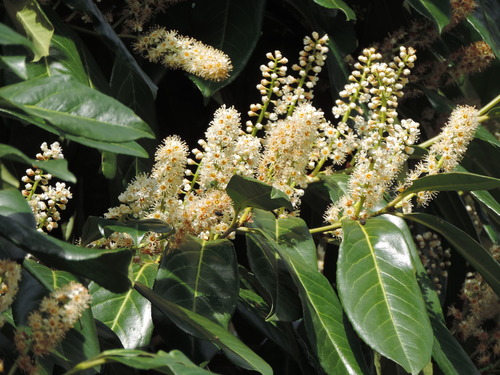
Cherry laurel
Prunus laurocerasus
A glossy-leaved evergreen powerhouse that provides essential year-round shelter and a seasonal feast for backyard birds.
Quick Identification
Size
A large evergreen shrub or small tree reaching 5–15 meters (16–50 ft) in height with a spread of 4–10 meters (13–33 ft).
Colors
Deep glossy green leaves; creamy white flowers; fruit transitions from green to bright red and finally shiny black.
Key Features
- Large, leathery, oblong leaves (10–25 cm long)
- Upright spikes of fragrant white flowers in spring
- Small, cherry-like black fruits
- Crushed leaves emit a distinct almond-like scent
When You’ll See Them
Geographic range
Where Does the Cherry laurel Live?
Native to the regions bordering the Black Sea, the Cherry laurel originated in southwestern Asia and southeastern Europe, stretching from Albania and Bulgaria through Turkey to the Caucasus Mountains and northern Iran. Today, it has become a global citizen, widely naturalized across Western Europe, the British Isles, and the Pacific Northwest of North America. In many of these introduced regions, it thrives so well in temperate climates that it is considered an opportunistic or even invasive species in forest understories.
Basemap © OpenStreetMap contributors
Behavior
The Cherry laurel is a vigorous, fast-growing evergreen that dominates the mid-story of a garden or woodland. Unlike many plants that simply sit still, the Cherry laurel is a hub of biological activity. It features extrafloral nectaries—small glands on the underside of the leaves that secrete nectar to attract ants and other predatory insects, which in turn protect the plant from herbivores.
In a backyard ecosystem, it acts as a primary provider of year-round structural cover. Its dense, interlocking branches and thick foliage create a nearly impenetrable windbreak and visual screen. While its leaves and seeds contain cyanogenic glycosides making them toxic to humans and most mammals, many bird species have evolved to safely consume the ripened black fruits, often spreading the seeds far and wide.
EverydayEarth exclusive
Camera Tips
Capturing the Cherry laurel effectively requires a shift in mindset: you aren't just filming a plant, you're filming a high-traffic biological 'hub.' Position your AI-powered camera about 4–6 feet away from a cluster of ripening berries during late summer. This is the optimal 'strike zone' for capturing Cedar Waxwings, Robins, and Thrushes as they hover or perch to pluck the fruit. Ensure the camera is slightly angled downward to catch the contrast of the black fruit against the glossy green leaves.
During the spring flowering phase, set your camera to a macro or close-up mode if available. The upright flower spikes (racemes) attract a dizzying array of pollinators, from honeybees to hoverflies. Because the leaves are highly reflective, avoid placing the camera facing directly into the sun, as the 'hot spots' of light bouncing off the waxy surface can wash out your images. North-facing placement provides the most consistent, soft lighting for the foliage.
For those interested in secret backyard visitors, aim your camera at the dark gaps beneath the lower branches of a mature laurel hedge. This dense 'skirting' is a preferred highway for nocturnal mammals like hedgehogs, foxes, or opossums who use the evergreen cover to move unseen. A low-angle placement, roughly 6 inches off the ground, will capture these critters as they emerge from the shadows of the laurel at dusk.
Similar Species
Species that look similar or are commonly confused with Cherry laurel.
Frequently Asked Questions
Record Cherry laurel at your habitat
Connect a camera to start building your own species record — AI identifies every visitor automatically.