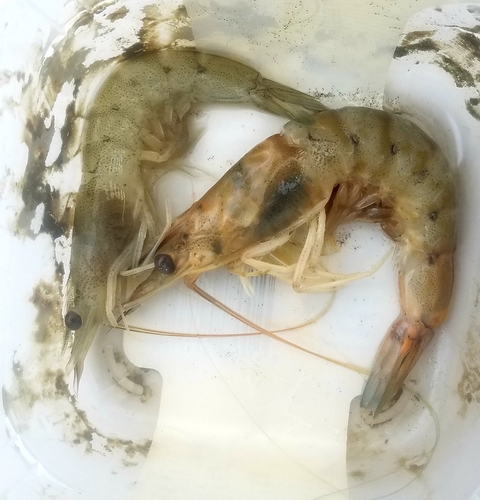
Bay Prawn
Metapenaeus bennettae
The Bay Prawn is the hidden gem of eastern Australian waterways, famous for its 'greasy' texture and vibrant green tail. A master of the midnight estuary, it thrives right in the backyards of coastal residents.
Quick Identification
Size
Typically 7.5 to 13 cm (3 to 5 inches) in length; weight ranges from 10 to 25 grams (0.35 to 0.9 oz).
Colors
Translucent cream or pale brown body with irregular mottled dark brown or olive spots; the most striking feature is the bright green or teal edging on the tail fan (uropods).
Key Features
- Distinctive green-tipped tail fan (uropods)
- Finely haired 'greasy' texture on the carapace
- Translucent body with brownish speckling
- Straight rostrum (head spike) with 6-9 teeth on the upper edge
When You’ll See Them
Geographic range
Where Does the Bay Prawn Live?
The Bay Prawn is a native treasure of the eastern Australian coastline, thriving in the brackish and marine waters of the Pacific seaboard. Its core range extends from the tropical warmth of Rockhampton in Central Queensland down through the temperate estuaries of New South Wales to the Gippsland Lakes in eastern Victoria. Because it can tolerate a wide range of salinities, it is frequently found far upstream in coastal rivers, making it one of the most common 'backyard' aquatic species for waterfront residents in eastern Australia.
Basemap © OpenStreetMap contributors
Behavior
Bay Prawns are predominantly nocturnal creatures that spend their daylight hours buried just beneath the surface of soft mud or sand. This burrowing behavior, aided by their 'greasy' shell texture which prevents silt from sticking too firmly, allows them to remain invisible to predators like flathead and herons. As night falls, they emerge from the substrate to forage along the bottom of estuaries and coastal lakes.
Unlike many other commercial prawn species in Australia, the Bay Prawn is unique because it can complete its entire life cycle—from egg to adult—within the confines of a coastal lagoon or estuary without ever needing to head out to the open ocean. They are highly social in terms of density, often found in massive 'schools' during the summer months, especially during the dark of the moon when they are most active near the water's surface.
EverydayEarth exclusive
Camera Tips
Capturing the Bay Prawn requires an underwater camera setup or a specialized waterproof trail cam positioned in shallow estuarine water. For the best results, mount your camera to a jetty pylon or a weighted tripod placed near the edge of a mangrove forest or seagrass bed during a rising tide. The camera should be angled slightly downward toward the muddy substrate where these prawns emerge to feed.
Lighting is the most critical factor for night shots. While white light can sometimes startle aquatic life, a low-intensity infrared or soft blue light often attracts small plankton, which in turn draws the Bay Prawn into the frame. Look for 'the run'—the period following a full moon when prawns move with the outgoing tide; this is the peak time for high-density activity.
If you are using an AI-powered camera in a waterproof housing, set the trigger sensitivity to high. Since prawns move with flicking motions, a fast shutter speed is necessary to avoid motion blur. To bait the area, a small mesh bag filled with pelletized fish food or crushed mollusks tied within view of the lens will keep them in the frame long enough for a clear identification of their green tail tips.
Similar Species
Species that look similar or are commonly confused with Bay Prawn.
Frequently Asked Questions
Record Bay Prawn at your habitat
Connect a camera to start building your own species record — AI identifies every visitor automatically.