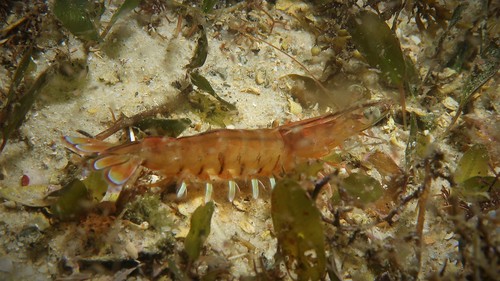
Eastern King Prawn
Penaeus plebejus
A master of the Australian coastline, the Eastern King Prawn is famous for its striking blue-tipped tail and its epic 1,000-kilometer northward migration through the Pacific depths.
Quick Identification
Size
Typically 15-22 cm (6-9 in), but can reach a maximum length of 30 cm (12 in) and weigh up to 190g (6.7 oz).
Colors
Creamy to pale yellow body with translucent segments; distinctive bright blue tips on the tail fins (uropods) and dark brown to purple banding on the tail segments.
Key Features
- Bright blue tips on the tail fins (uropods)
- Long rostrum (head spike) with teeth on both upper and lower edges
- Pale, translucent body with subtle vertical striping
- Two pairs of long antennae
When You’ll See Them
Geographic range
Where Does the Eastern King Prawn Live?
The Eastern King Prawn is native to the Oceania region, found exclusively along the eastern coastline of Australia. Its core range extends from the northern tropical waters of Queensland, moving south through New South Wales, and reaching the cooler temperate waters of eastern Victoria and the northeastern coast of Tasmania. While they are a single continuous population, they are most abundant in the subtropical regions where they gather in large numbers during their annual northward migration.
Basemap © OpenStreetMap contributors
Behavior
Eastern King Prawns are primarily nocturnal scavengers that spend their daylight hours buried in the sandy or muddy substrate of the ocean floor to avoid predators. At night, they emerge to forage, using their delicate chelae (claws) to sift through the sediment for food. They are highly active swimmers, using their pleopods (swimmerets) for steady movement and their powerful tail fan for rapid backwards 'flicks' when threatened.
One of the most remarkable aspects of their behavior is their life-cycle migration. Juveniles grow in protected estuaries and coastal lakes before moving out to sea as they mature. Once in the open ocean, they undertake a massive northward migration along the Australian coastline, traveling up to 1,000 kilometers to reach warmer spawning grounds. This makes them one of the most mobile crustacean species in the world.
EverydayEarth exclusive
Camera Tips
To capture the Eastern King Prawn, you will need an underwater setup. For those with coastal properties or docks, mounting a waterproof action camera (like a GoPro with an external battery pack) or a specialized aquatic trail camera to a weighted base is the best approach. Position the camera on a flat, sandy patch near seagrass beds or pier pilings, as prawns prefer these transition zones for foraging and protection. The lens should be angled slightly downward toward the seafloor to capture them as they emerge from the sand.
Since these prawns are strictly nocturnal, artificial lighting is a necessity. Using a camera with infrared (IR) capabilities is ideal to avoid scaring the prawns, but a low-intensity red light can also work well as many crustaceans have limited sensitivity to red spectrum light. Standard white lights may cause them to 'flick' away or bury themselves. Set your camera to record short video clips (15-30 seconds) rather than still photos, as the movement of their antennae and swimming legs is a key part of their charm and helps in identification.
Baiting is highly effective for drawing Eastern King Prawns into the frame. Use a small mesh bait bag filled with oily fish like sardines or even wet cat food. Secure the bait bag roughly 30-50 cm in front of the lens. The scent will draw them from the surrounding sand. The best time to deploy your camera is during a new moon and on an incoming high tide at night, which is when prawns are most active and likely to be moving through estuarine 'choke points' or feeding on the flats.
Similar Species
Species that look similar or are commonly confused with Eastern King Prawn.
Frequently Asked Questions
Record Eastern King Prawn at your habitat
Connect a camera to start building your own species record — AI identifies every visitor automatically.