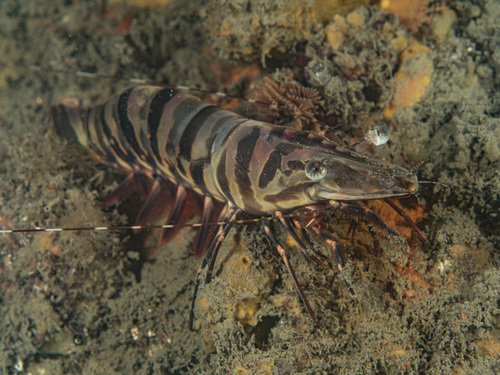
Brown Tiger Prawn
Penaeus esculentus
Meet the 'Tiger of the Reef,' a master of camouflage that rules the Australian seafloor under the cover of darkness. With its striking banded armor and elusive nature, the Brown Tiger Prawn is a fascinating subject for any underwater explorer.
Quick Identification
Size
Total length of 15-25 cm (6-10 inches); weights typically range from 30-110g (1-4 oz).
Colors
Characteristic alternating bands of dark brown and pale tan or yellow; tail fan often features subtle blue or red highlights at the tips.
Key Features
- Bold dark brown transverse bands across the entire body
- Rostrum (head spike) with 6-7 teeth on the top edge
- Large, dark compound eyes on prominent stalks
- Absence of deep grooves on the carapace compared to similar species
When You’ll See Them
Geographic range
Where Does the Brown Tiger Prawn Live?
The Brown Tiger Prawn is an iconic Australian endemic species, found nowhere else in the world. Its distribution hugs the northern and eastern coastlines of the continent, spanning from the central coast of New South Wales, up through the tropical waters of Queensland and the Gulf of Carpentaria, and stretching across to the Shark Bay region in Western Australia. It is a true shelf-dwelling species, rarely venturing far into the deep ocean, preferring the nutrient-rich waters near the coast.
Basemap © OpenStreetMap contributors
Behavior
The Brown Tiger Prawn is a reclusive, nocturnal crustacean that spends the majority of its daylight hours buried beneath the seafloor. By using its pleopods to excavate a shallow depression and then settling into the sand or mud, it effectively disappears from the sight of predators like rays and bony fish. This burrowing behavior is a key survival strategy in the relatively open habitats of seagrass beds and estuaries.
As night falls, the prawn emerges to hunt and scavenge. They are primarily solitary hunters, using their highly sensitive chemosensory antennae to detect food particles and prey in the water column and sediment. While they are capable of slow, graceful swimming, they are best known for their 'tail-flick' response—a lightning-fast backward retreat triggered by the abdominal muscles when they feel threatened.
EverydayEarth exclusive
Camera Tips
Capturing high-quality footage of a Brown Tiger Prawn requires a waterproof camera setup, such as a GoPro or a dedicated underwater trail camera. If you have a backyard dock, canal frontage, or access to a local jetty, the best approach is to mount your camera to a weighted frame or a pylon. Position the lens so it is looking across the sandy or muddy floor at a slight downward angle, roughly 10-15 centimeters above the substrate. This perspective is ideal for catching the moment the prawn emerges from its burrow at dusk.
Because Brown Tiger Prawns are strictly nocturnal and have sensitive eyes, traditional white light can startle them and cause them to flee. Use an underwater housing equipped with red light or infrared (IR) LEDs. Prawns are less sensitive to the red end of the spectrum, allowing you to observe their natural foraging behavior without triggering their 'escape flick' response. If your camera allows, a high frame rate of 60fps or higher is recommended to capture the incredible speed of their movement if they are startled by a predator.
To guarantee a sighting, use a scent-based attractant. A small mesh 'bait bag' filled with crushed oily fish, such as sardines or mullet, is irresistible to these scavengers. Secure the bag in the center of your camera’s focal point. For the clearest images, time your recording with the high tide when the water is typically less turbid. Avoid nights with heavy swell, as the suspended sediment will cause 'backscatter' in your footage, making it difficult to see the fine details of the prawn's tiger-striped markings.
Similar Species
Species that look similar or are commonly confused with Brown Tiger Prawn.
Frequently Asked Questions
Record Brown Tiger Prawn at your habitat
Connect a camera to start building your own species record — AI identifies every visitor automatically.