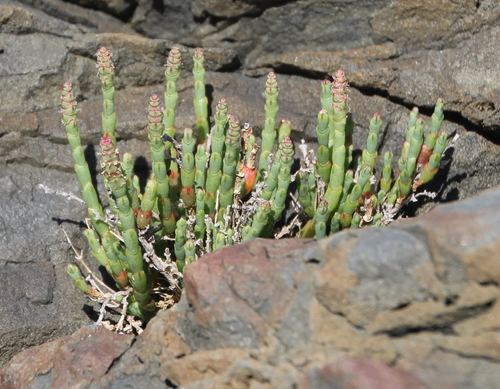
Beaded Samphire
Salicornia quinqueflora
The Beaded Samphire is a coastal warrior, turning harsh, salty mudflats into a kaleidoscope of succulent red and green beads.
Quick Identification
Size
Height 10–50 cm (4–20 inches); individual mats can spread up to 2 metres (6.5 feet) wide.
Colors
Bright green to teal blue stems that often turn vibrant shades of red, orange, or purple during autumn and winter.
Key Features
- Segmented, bead-like succulent stems
- Opposite, scale-like leaves reduced to tiny sheaths
- Creeping or sprawling mat-forming habit
- Turns bright red in response to salt stress or cold
- Tiny, inconspicuous flowers embedded in the stem joints
When You’ll See Them
Geographic range
Where Does the Beaded Samphire Live?
Native to the coastal regions of the Oceania continent, the Beaded Samphire is a dominant feature of the Australian and New Zealand shorelines. In Australia, it is found along the coasts of all mainland states and is particularly abundant in the temperate south and throughout Tasmania. In New Zealand, it thrives across both the North and South Islands, as well as on Stewart Island, hugging the narrow strip of land where the ocean meets the shore.
Basemap © OpenStreetMap contributors
Behavior
Beaded Samphire is a remarkable halophyte, a plant specifically adapted to survive in highly saline environments where most vegetation would wither. It manages salt by sequestering it into its succulent, bead-like segments. When a segment reaches its salt capacity, it often turns red and eventually drops off, effectively shedding excess salt from the plant's system.
As a foundational species in coastal ecosystems, it plays a critical role in land formation and stabilization. Its dense mats trap sediment and organic matter, helping to build up soil levels in salt marshes and preventing shoreline erosion. While it doesn't 'behave' in the animal sense, it responds dynamically to the tides, surviving total immersion during high tide and intense evaporation during low tide.
In the ecosystem, it acts as a vital 'nursery' and shelter. Small crustaceans, mollusks, and juvenile fish navigate the submerged stems at high tide, while at low tide, the mats provide a damp, cool refuge for salt-marsh specialized insects and spiders, which in turn attract foraging shorebirds.
EverydayEarth exclusive
Camera Tips
Capturing the Beaded Samphire with an AI-powered trail camera requires a focus on landscape aesthetics and micro-habitats. Because the plant is low-growing, mount your camera on a ground-level stake or a very low tripod. Aim for a wide-angle perspective that captures the 'carpet' effect of the samphire against the backdrop of the ocean or estuary. This low angle also allows the camera to detect visiting wildlife like crabs or shorebirds that move through the stems.
Time-lapse mode is your best friend with this species. Set your camera to take a photo every 15 to 30 minutes. This will allow you to create a stunning sequence showing the tide coming in and out, documenting how the plant looks when fully submerged versus when it is dry and glistening in the sun. This technique also captures the slow but beautiful color transition from green to deep crimson during the cooler months.
Lighting is the most critical factor for photographing succulents. The bead-like segments of the Beaded Samphire are semi-translucent. To make them 'glow,' try to position your camera so it is slightly backlit during the golden hours of sunrise or sunset. This brings out the internal structure of the beads and emphasizes the vibrant reds and purples that make this plant so iconic.
Since these environments are salty and damp, ensure your camera housing is rated for high humidity and salt spray. Check the lens regularly for salt crusting, which can blur the image. If you are targeting 'backyard' coastal wildlife, place the camera near a path or a gap in the samphire mat, as small mammals or reptiles like skinks often use these clearings as 'highways' through the dense vegetation.
Similar Species
Species that look similar or are commonly confused with Beaded Samphire.
Frequently Asked Questions
Record Beaded Samphire at your habitat
Connect a camera to start building your own species record — AI identifies every visitor automatically.