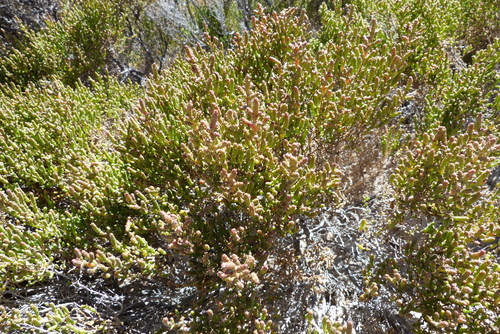
Grey Samphire
Tecticornia halocnemoides
A master of the salt flats, the Grey Samphire is a succulent survivor that paints the Australian landscape in shades of grey-green and fiery crimson. This hardy shrub thrives where others wither, providing a vital sanctuary for specialized coastal wildlife.
Quick Identification
Size
Height of 10–50 cm (4–20 inches) with a spreading width often reaching 1 metre (3.3 feet)
Colors
Dull grey-green to waxy blue-grey (glaucous); segments frequently turn vivid red, orange, or bronze during periods of high salinity or cold weather
Key Features
- Segmented, succulent 'bead-like' stems
- Highly reduced, inconspicuous flowers embedded in stem joints
- Spreading or erect woody base
- Waxy, salt-resistant greyish-green foliage
When You’ll See Them
Geographic range
Where Does the Grey Samphire Live?
Grey Samphire is a quintessential Australian native, widely distributed across the continent in virtually every state and territory. It is particularly dominant in the arid interior around massive salt lake systems like Lake Eyre, as well as along the vast coastlines of Western Australia and South Australia. While it thrives in the harsh outback, it is also a common sight in the salt marshes and mangrove fringes near major coastal cities like Adelaide, Perth, and Melbourne.
Basemap © OpenStreetMap contributors
Behavior
Grey Samphire is a resilient halophyte, a specialized plant capable of thriving in environments with high salt concentrations that would kill most other vegetation. Instead of traditional leaves, it features fleshy, segmented stems that store water and salt. Its growth pattern is slow but steady, forming dense mats or low shrubs that provide essential cover for coastal and salt-lake fauna. Unlike many garden plants, its 'behavior' is dictated by the tide and soil salinity, with the plant actively accumulating salts in its segments to help it draw moisture from the brine.
For the backyard observer or nature enthusiast, the Grey Samphire serves as a seasonal barometer. During the hotter, drier months, or as the soil becomes more saline, the plant undergoes a dramatic color shift. The grey-green segments transition into brilliant shades of crimson and purple, a physiological response to stress. It shares a symbiotic relationship with local insects and small ground-dwelling birds, providing both a food source and a sheltered micro-habitat in otherwise exposed, harsh landscapes.
EverydayEarth exclusive
Camera Tips
Capturing the Grey Samphire on a trail or backyard camera requires a different approach than moving wildlife. Because the plant is stationary, it is the perfect subject for time-lapse photography. Set your camera to take a shot once or twice a day over several months to witness the spectacular color transition from dull grey-green to fiery red. Use a low-angle mount, such as a ground stake, to position the camera just 15–20 cm (6–8 inches) off the ground. This 'worm's eye view' emphasizes the architectural, bead-like structure of the succulent stems.
If your AI camera is equipped with macro capabilities, focus on the nodes between the segments. During the flowering season, you can capture the tiny, almost invisible flowers emerging from the joints. To attract animal visitors to the frame, place the camera near a patch of Samphire that sits on the edge of a water source. Small birds like the Orange-bellied Parrot (in specific regions) or various honeyeaters often forage around these plants, and the Samphire provides a beautiful, textured foreground for these shots.
Lighting is critical for this species due to its waxy, reflective surface. Aim for 'Golden Hour' timing—the hour after sunrise or before sunset—to avoid the harsh glare that can wash out the subtle grey-blue tones of the plant. If you are monitoring a backyard salt-patch or a coastal property, ensure your camera lens is cleaned regularly, as salt spray can quickly build up on the glass and blur your images. For the best results, use a camera with a high dynamic range (HDR) setting to capture the detail in both the shadows of the dense shrub and the bright, waxy highlights of the succulent beads.
Similar Species
Species that look similar or are commonly confused with Grey Samphire.
Frequently Asked Questions
Record Grey Samphire at your habitat
Connect a camera to start building your own species record — AI identifies every visitor automatically.