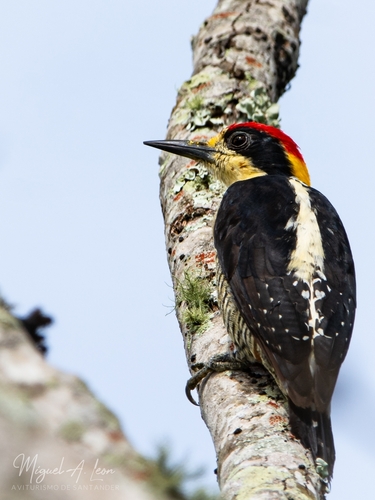
Beautiful Woodpecker
Melanerpes pulcher
A stunning endemic of the Magdalena Valley, the Beautiful Woodpecker dazzles with its zebra-striped back and vibrant splashes of gold and red. This social bird is a must-see for anyone exploring the tropical forests of Colombia.
Quick Identification
Size
Length: 17–18 cm (6.7–7.1 in); Weight: 42–56 g (1.5–2.0 oz)
Colors
Black and white barred back; golden-yellow forehead; red belly patch; males have a red crown, females have a black hindcrown.
Key Features
- Bold black-and-white barred upperparts
- Distinct golden-yellow forehead patch
- Vibrant red central belly patch
- Black mask stripe through the eye
When You’ll See Them
Geographic range
Where Does the Beautiful Woodpecker Live?
The Beautiful Woodpecker is a South American treasure found exclusively in the country of Colombia. Its core range is centered in the Middle Magdalena Valley and extends into the northern foothills of the Central and Western Andes. This endemic bird is a specialist of the humid lowlands, thriving in the lush, tropical corridors of north-central Colombia.
Basemap © OpenStreetMap contributors
Behavior
Unlike some of their more reclusive relatives, these woodpeckers are relatively bold and can be seen foraging in the open on dead limbs or at the edges of clearings. They are known to be cooperative breeders on occasion, where older offspring help the breeding pair protect the nest and feed the new brood, showcasing a complex social structure.
EverydayEarth exclusive
Camera Tips
In a backyard or garden setting, these birds are highly attracted to fruit. Secure overripe bananas, plantains, or halved papayas to a wooden platform within the camera's field of view. The bright colors of the fruit often act as a visual lure, and the social nature of the species means you might even capture two or three birds interacting at the same time.
Set your camera to a 'Photo Burst' mode or short 10-second video clips. Woodpeckers move their heads with incredible speed, and a single still photo often captures them mid-blur or looking away. Video is especially effective for documenting their unique drumming rhythm, which can help in identifying individuals or local populations.
Since they inhabit humid, often overcast tropical regions, light can be a challenge. Position your camera facing away from the morning sun to maximize natural illumination on the bird's breast and belly, where the namesake 'beautiful' red and gold markings are located. If your camera has adjustable sensitivity, use a high-speed trigger setting to ensure you don't miss the bird as it darts from the trunk to the fruit.
Similar Species
Species that look similar or are commonly confused with Beautiful Woodpecker.
Black-cheeked Woodpecker
Very similar but found further north; the Beautiful Woodpecker has less yellow on the nape and a slightly different facial pattern.
Red-crowned Woodpecker
Commonly seen in the same areas but has a much lighter, tan-colored face and lacks the heavy black-and-white zebra barring.
Frequently Asked Questions
Record Beautiful Woodpecker at your habitat
Connect a camera to start building your own species record — AI identifies every visitor automatically.