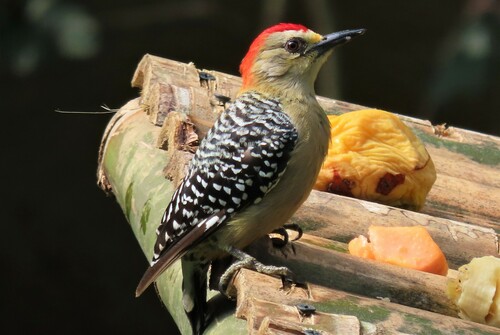
Red-crowned Woodpecker
Melanerpes rubricapillus
Meet the Red-crowned Woodpecker, the vibrant and vocal 'zebra of the trees.' With its striking barred plumage and energetic personality, it is a favorite for backyard birdwatchers across the Neotropics.
Quick Identification
Size
Length: 16–18.5 cm (6.3–7.3 in); Weight: 40–60 g (1.4–2.1 oz)
Colors
Zebra-like black and white horizontal barring on the back and wings; pale buffy-gray face and underparts. Males have a bright red crown and nape; females have a pale forehead and crown with red limited to the nape.
Key Features
- Distinctive black-and-white 'zebra' barred back
- Pale grayish-tan underparts with a small reddish patch on the lower belly
- Male has red from forehead to nape; female has a pale crown
- Short, pointed bill and stiff tail feathers used for bracing against tree trunks
When You’ll See Them
Sightings on EverydayEarth
Jun 29, 2026
A pair of Red-crowned Woodpeckers and a Crimson-backed Tanager are gathered on a fruit-filled tray. The tanager hops briefly before flying off to the left, while the two woodpeckers remain, methodically pecking at slices of orange and papaya.
Jun 29, 2026
Several Red-crowned Woodpeckers are busy at the feeding station. One perches on a mossy branch above while another feeds on fruit slices on the tray. A third woodpecker flies in and lands near a bromeliad on the branch. Towards the end of the sequence, a brightly colored Crimson-backed Tanager quickly lands on the feeder to join the activity.
Jun 29, 2026
Two Red-crowned Woodpeckers are actively feeding on orange and papaya slices arranged on a mossy log and a feeder tray. A few small, bright yellow Thick-billed Euphonias are also visiting the site, hopping between the fruit and the surrounding vegetation.
Jun 29, 2026
A Red-crowned Woodpecker and a male Thick-billed Euphonia are both present on the feeder platform, feeding on sliced oranges and papaya. The woodpecker occupies the left side, pecking at the fruit, while the smaller euphonia feeds on the right.
Jun 29, 2026
Multiple tropical birds are visiting the fruit feeder simultaneously. A Red-crowned Woodpecker forages on the central log while a Clay-colored Thrush stands on the right edge of the tray. A Crimson-backed Tanager is perched on the mossy branch to the left, occasionally hopping between spots.
Jun 28, 2026
A Red-crowned Woodpecker perches on a moss-covered branch, pecking at the wood and looking around. Seconds later, a small yellowish-green Thick-billed Euphonia flies in and lands on the feeder tray near several orange slices.
Behavior
These woodpeckers are active foragers, spending their day hopping vertically up tree trunks or hanging from the ends of branches to reach fruit. They are known for their 'drumming'—a rhythmic pecking on resonant wood—which they use to declare territory or attract a mate. In garden settings, they are curious and can become quite bold, often being among the first species to investigate a new bird feeder or a freshly cut piece of fruit left out by homeowners.
EverydayEarth exclusive
Camera Tips
To capture high-quality footage of a Red-crowned Woodpecker, the best strategy is to focus on their vertical lifestyle. Mount your camera 5 to 8 feet high on a tree trunk that shows signs of activity, such as small peck marks or 'sap wells.' Unlike ground-feeding birds, these woodpeckers will almost always land on the side of a tree and hop upward. For the best angle, place your camera on a nearby parallel tree or a post, angled slightly toward the main trunk where you’ve noticed them foraging. This side-profile view allows the AI to easily distinguish the male's full red crown from the female's nape-only red marking.
Food is the ultimate lure for this species. They are famously 'fruit-hungry' and will regularly visit a platform feeder if it is stocked with halved papayas, ripe bananas, or oranges. If you are using a trail camera, try 'shish-kebabing' fruit onto a cut branch or a specialized feeder tray within the camera's focal range. Because they are bold, you can place the camera relatively close—about 3 to 5 feet away—to get stunningly detailed macro shots of their plumage. If you have suet feeders, ensure your camera is positioned to capture the bird's tail, as they use it like a tripod to balance while eating, providing a classic woodpecker silhouette.
Setting your camera to video mode or a high-speed burst is essential. Red-crowned Woodpeckers move with sudden, jerky motions and quick head bobs that can blur a standard photo. A 10-second video clip is often enough to capture their 'churr' call or their rhythmic drumming. During the breeding season (February to July), they often excavate holes in dead palm trees or soft wood; if you locate a nest site, place your camera at least 15 feet away to avoid disturbing them. Using a zoom lens or high-resolution setting will allow you to see the fascinating interactions between parents and chicks without getting too close to their home.
Similar Species
Species that look similar or are commonly confused with Red-crowned Woodpecker.
Hoffmann's Woodpecker
Hoffmann's has a distinct yellow-to-orange nape and is found primarily in the dry Pacific slope, whereas the Red-crowned is more widespread in humid and garden areas.
Red-bellied Woodpecker
While similar in 'zebra' patterning, the Red-bellied Woodpecker is found in North America and is larger with a more extensive red wash on the belly.
Frequently Asked Questions
Record Red-crowned Woodpecker at your habitat
Connect a camera to start building your own species record — AI identifies every visitor automatically.