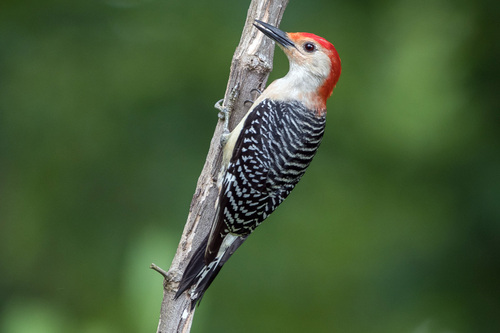
Red-bellied Woodpecker
Melanerpes carolinus
The Red-bellied Woodpecker is the vibrant, vocal percussionist of the eastern woods. With its striking zebra-striped back and flash of crimson, it’s a frequent and charismatic visitor to backyard suet feeders.
Quick Identification
Size
Length: 9-10.5 in (23-27 cm) | Wingspan: 13-16.5 in (33-42 cm) | Weight: 2-3.2 oz (56-91 g)
Colors
Distinctive black-and-white 'zebra' barred back and wings. Grayish-white underparts with a faint reddish wash on the lower belly. Males feature a bright red cap extending from the bill to the nape; females have red only on the nape (back of the neck).
Key Features
- Black and white horizontal 'zebra' barring on back
- Red nape (males also have red crown)
- Pale grayish face and underparts
- Long, chisel-like black bill
- Stiff tail feathers used for propping against tree trunks
When You’ll See Them
Sightings on EverydayEarth
Apr 28, 2026
A male Red-bellied Woodpecker lands on the feeder tray and begins searching through the seeds, looking around alertly. In the background, an American Robin perches briefly on a nearby feeder hook before flying off.
Jun 7, 2026
A Red-bellied Woodpecker lands on the feeder tray and spends time carefully selecting seeds. It pauses several times to look around and directly into the camera, providing clear views of its vibrant red head and the distinctive 'zebra' pattern on its back.
May 27, 2026
A male Red-bellied Woodpecker lands on the edge of the feeder tray. It looks directly at the camera, then scans the surrounding yard before turning to reveal its barred back feathers and flying away.
May 25, 2026
A Red-bellied Woodpecker lands on the edge of the feeder tray. It pauses to look around, displaying its barred plumage, before leaning in to inspect the seeds.
May 16, 2026
A male Red-bellied Woodpecker lands on the edge of the feeder tray. It spends a few moments peering into the seeds and adjusting its position before flying away across the lawn.
May 11, 2026
A male Red-bellied Woodpecker lands on the feeder tray and sifts through the various seeds and corn. It carefully selects a large peanut before taking flight.
Behavior
Red-bellied Woodpeckers are charismatic and vocal birds known for their undulating flight patterns and rhythmic drumming. Unlike some shy forest birds, they have adapted remarkably well to human presence and are a frequent sight in suburban backyards. They are 'hitchers,' meaning they move up tree trunks in short hops, using their stiff tail feathers as a tripod for stability while they probe crevices for food.
These woodpeckers are also known for their caching behavior. You may observe them wedging nuts or seeds into deep furrows in tree bark to save for later consumption during the winter months. They are highly territorial during the breeding season and use loud 'kwirr' calls to signal their presence to rivals and mates alike. While they are bold at feeders, they often have to compete with larger birds or aggressive European Starlings for nesting cavities.
EverydayEarth exclusive
Camera Tips
To capture high-quality images of the Red-bellied Woodpecker, the most effective strategy is to target a vertical surface. Position your camera 5 to 6 feet off the ground, facing a thick-barked tree like an oak, maple, or pine. Because these birds prefer to 'hitch' up a trunk rather than perch on a thin branch, mounting a suet cage or a specialized woodpecker 'log' feeder directly in the camera's field of view is ideal. Ensure the camera is angled slightly downward to capture the bird's head and back, which highlights the identifying red markings and zebra-striping.
Lighting is crucial for this species; their white and black feathers can easily 'blow out' in direct midday sun. Try to position your camera facing North or South to avoid harsh backlighting. Since they are high-energy birds, use a 'Burst' or 'Multi-shot' mode if your camera supports it. This increases the chances of catching that perfect moment when they are mid-peck or tossing a seed. If you are using video, look for a camera with a high-quality microphone—the 'drumming' sound and their unique 'kwirr' calls are just as distinctive as their appearance.
For bait, suet is the gold standard, especially those containing peanuts or mealworms. In the colder months, a smeared mixture of peanut butter and cornmeal on a tree trunk can keep a Red-bellied Woodpecker in front of your lens for several minutes as they work to extract the treat. In late summer and fall, adding a few orange halves or a dish of grape jelly nearby may also attract them, as they have a surprising sweet tooth for fruit and nectar.
Similar Species
Species that look similar or are commonly confused with Red-bellied Woodpecker.
Red-headed Woodpecker
The Red-headed has an entirely crimson head and neck with a solid black back, unlike the Red-bellied's zebra-striped back and partial red crown.
Northern Flicker
Flickers are browner overall with a black crescent on the chest and spotted bellies, lacking the zebra-style back barring.
Hairy Woodpecker
Smaller with a solid white stripe down the center of the back and no red on the crown (only a small red patch on the back of the male's head).
Frequently Asked Questions
Record Red-bellied Woodpecker at your habitat
Connect a camera to start building your own species record — AI identifies every visitor automatically.