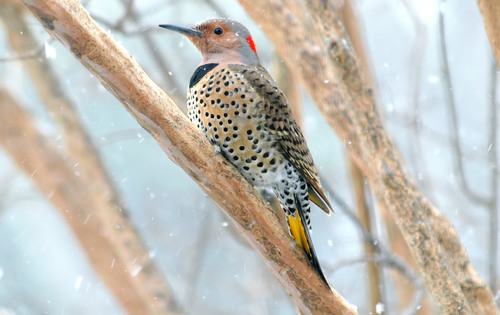
Northern Flicker
Colaptes auratus
A ground-dwelling woodpecker with a penchant for ants and a coat of many colors, the Northern Flicker is a backyard favorite. Its rhythmic 'wick-a-wick-a' call and sudden flashes of golden or crimson wings make it one of North America's most charismatic feathered visitors.
Quick Identification
Size
Length: 11–12 in (28–31 cm); Wingspan: 16.5–20 in (42–51 cm); Weight: 3.9–5.6 oz (110–160 g)
Colors
Tan and grey body with bold black spots on the belly; black crescent bib on the upper chest; brown back with black horizontal bars. Subspecies show either yellow (East) or red (West) underwings. Males feature a black or red 'mustache' stripe.
Key Features
- Large black crescent 'bib' on the upper breast
- White rump patch highly visible during flight
- Tan belly covered in bold black spots
- Yellow or red shafts on flight feathers depending on region
When You’ll See Them
Sightings on EverydayEarth
Jul 14, 2026
A Northern Flicker lands on the right side of the large stick nest. It spends several seconds foraging through the nest material and vocalizing with its beak open before moving slightly out of view.
Jul 2, 2026
A Northern Flicker is perched on a branch to the right of a large stick nest, remaining mostly still while surveying the landscape.
Jun 24, 2026
A Common Grackle lands in the feeder tray, methodically searching for seeds and tossing some aside. A male Red-winged Blackbird is seen flying off from a feeder in the upper left at the beginning of the clip, while a Northern Flicker takes flight from the leftmost suet feeder later in the sequence, showing its characteristic white rump and yellow underwings.
Jun 22, 2026
A Northern Flicker is perched on the leftmost suet feeder, using its long bill to feed while clinging to the mesh. On the central platform feeder, a Common Grackle hops around, appearing slightly wet as it searches for seeds. A second grackle is briefly visible perching higher up on the central post before the flicker flies away.
Jun 17, 2026
A male Northern Flicker is actively foraging along the bottom-right edge of a large stick nest. It hops between the branches, pecking at the nest lining and occasionally looking around while emitting its distinct vocalizations.
Jun 16, 2026
A very busy scene at the feeder station with multiple species feeding simultaneously. A male Red-winged Blackbird flies in and lands on the platform tray alongside several females. A Mourning Dove also feeds on the tray. Meanwhile, a male Downy Woodpecker occupies the leftmost suet feeder, a Northern Flicker feeds from a tube feeder, and a European Starling visits a small hanging suet cage.
Behavior
The Northern Flicker is a unique member of the woodpecker family that spends a surprising amount of time on the ground. While most woodpeckers hammer away at tree trunks for larvae, Flickers specialize in hunting ants and beetles by probing the soil with their long, slightly curved bills. They are often seen hopping across lawns or open forest floors, using their sticky tongues—which can extend two inches past the tip of their beak—to lap up insects.
Socially, Flickers are known for their loud, ringing calls and rhythmic drumming, which they use to claim territory and attract mates. In the spring, you might hear them drumming on metal chimneys or gutters, as the resonance helps their message travel further. Though they are somewhat wary of humans, they are frequent visitors to suburban backyards, especially those with bird baths or suet feeders.
EverydayEarth exclusive
Camera Tips
To capture the best footage of a Northern Flicker, think low. Unlike other woodpeckers that you’d look for high in the canopy, Flickers are ground-feeders. Place your AI-powered camera 1 to 2 feet off the ground, angled slightly downward toward a patch of short grass or a mulch bed. If you have an active anthill in your yard, that is the ultimate 'hotspot'—aim your camera there for incredible close-up foraging shots.
If you prefer a feeder setup, high-energy suet cakes are your best bet. Because Flickers are larger birds, use a suet cage with a tail-prop (a long wooden extension below the feeder) to help them balance comfortably. Position the camera about 3-5 feet away from the feeder to ensure the bird fits entirely in the frame, especially when it spreads its wings to show off those brilliant yellow or red shafts.
Water is another powerful lure. Flickers love a good bath, and because they are larger than songbirds, they prefer wider, shallow basins. Set your camera to 'Burst Mode' or high-frame-rate video. Flickers have a very rapid 'head-bobbing' motion while foraging and drinking, so a fast trigger speed is essential to avoid motion blur. Early morning light is ideal, as it highlights the iridescent quality of their feathers and the vibrant colors under their wings.
In the winter, try offering hulled sunflower seeds or peanuts on a platform feeder. During this time, they become less territorial and more focused on high-calorie treats. If you are using a trail camera in a more wooded area, look for 'drumming' trees—often dead snags with hollow cavities—and mount the camera at eye level on a neighboring tree to catch their territorial displays.
Similar Species
Species that look similar or are commonly confused with Northern Flicker.
Pileated Woodpecker
Much larger with a bright red crest and mostly black body, whereas the Flicker is smaller, brown-toned, and spotted.
Gilded Flicker
Almost identical but limited to desert habitats; it has yellow underwings but a cinnamon-colored crown.
Red-bellied Woodpecker
Has a zebra-striped back but lacks the Northern Flicker's black chest crescent and spotted belly.
Frequently Asked Questions
Record Northern Flicker at your habitat
Connect a camera to start building your own species record — AI identifies every visitor automatically.