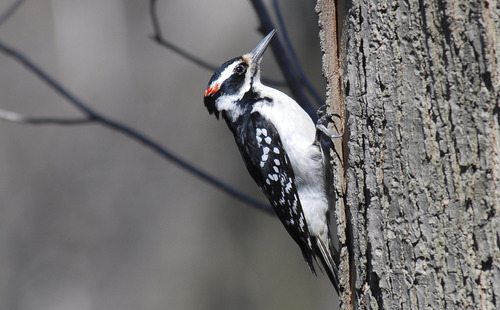
Hairy Woodpecker
Leuconotopicus villosus
A powerful excavator of the forest, the Hairy Woodpecker is a striking visitor known for its bold patterns and rhythmic drumming. A larger, more robust relative of the Downy Woodpecker, it is a rewarding species to attract to any backyard sanctuary.
Quick Identification
Size
Length: 18-26 cm (7.1-10.2 in) | Wingspan: 33-41 cm (13-16 in) | Weight: 40-95 g (1.4-3.4 oz)
Colors
Contrast of black and white; white underparts and a prominent white patch down the back; black wings with white spotting; males feature a small red patch on the back of the head.
Key Features
- Large, chisel-like bill nearly as long as the head
- Prominent white stripe down the center of the back
- Stiff, pointed tail feathers used for support against bark
- Sharp, metallic 'peek' call note
When You’ll See Them
Sightings on EverydayEarth
Jul 30, 2026
The feeding station is very active with a variety of species. Several male Red-winged Blackbirds are prominent, showing off their bright epaulets, while streaked females and juveniles forage on the tray. A male Hairy Woodpecker is steadily working on the suet feeder to the left. Common Grackles and Brown-headed Cowbirds cycle through, landing and departing in a flurry of mid-summer activity.
Jul 29, 2026
During a light rain, a male Hairy Woodpecker clings to the central feeder post, working on a block of suet. On the left, a Tufted Titmouse briefly visits the hanging feeders, while a male Red-winged Blackbird arrives at the tube feeder on the right toward the end of the sequence.
Jul 23, 2026
A busy scene at the feeder station during the golden hour. A Mourning Dove sits quietly in the seed tray while a Common Grackle lands beside it. On the far left, a Hairy Woodpecker is actively feeding on a suet log, while several other grackles and smaller birds flit between the tube feeders in the background.
Jul 20, 2026
A Blue Jay dominates the foreground, landing on the large seed tray to sift through the offerings and select a nut. In the background, a Hairy Woodpecker is perched on the central vertical feeder, actively pecking at the food. A third, dark-colored bird makes a very brief appearance at the tube feeder on the right.
Jul 20, 2026
A busy summer afternoon at the feeder complex. A Blue Jay and a Mourning Dove are initially seen sharing the main tray, while a Hairy Woodpecker clings to the suet feeder on the left. A second dove flies in, causing the first to depart, while the Blue Jay remains to forage for seeds and the woodpecker continues feeding.
Jul 19, 2026
The feeder is bustling with mid-morning activity. A Mourning Dove and a Common Grackle occupy the main tray feeder, while several Red-winged Blackbirds and more grackles cycle through the surrounding tube feeders. On the far left, a male Hairy Woodpecker clings to a log-style suet feeder, working its way around the holes.
Geographic range
Where Does the Hairy Woodpecker Live?
The Hairy Woodpecker is a quintessential North American resident, claiming a massive range that stretches from the tree line in Alaska and across Canada down to the mountains of Panama. Within the United States, they are found in nearly every state, flourishing in both the dense temperate rainforests of the Pacific Northwest and the mixed hardwood forests of the East Coast. Because they are largely non-migratory, these birds are permanent fixtures in their local ecosystems, providing year-round opportunities for backyard observation across the continent.
Basemap © OpenStreetMap contributors
Behavior
The Hairy Woodpecker is an industrious and powerful forager, often heard before it is seen. Unlike its smaller cousin, the Downy Woodpecker, the Hairy tends to focus its efforts on the main trunks and large branches of mature trees, using its heavy bill to excavate deep into the wood for larvae. They are known for their energetic drumming, a rapid-fire rhythmic tapping used to establish territories and attract mates during the spring.
While they are somewhat more reclusive than Downy Woodpeckers, they are frequent visitors to backyard feeders, especially in wooded suburban areas. They are generally solitary outside of the breeding season, though mated pairs often maintain loosely overlapping territories year-round. Their flight is characteristic of most woodpeckers, featuring an undulating, up-and-down pattern as they move between trees.
EverydayEarth exclusive
Camera Tips
To capture high-quality footage of a Hairy Woodpecker, the most effective strategy is to mount your camera near a high-energy food source. Suet cages are the gold standard for attracting this species. Position your camera about 5 to 7 feet (1.5 to 2 meters) off the ground, angled slightly downward toward the feeder. If possible, mount the feeder on the trunk of a mature tree rather than a metal pole; Hairy Woodpeckers feel much more secure landing on bark and hitching their way up to the food.
Because these birds are fast movers with powerful pecking motions, use a fast shutter speed or a high-frame-rate video setting (at least 60fps) to avoid motion blur. If your camera allows for focal adjustments, set it to focus on the area just in front of the feeder. Hairy Woodpeckers are larger and more skittish than many backyard birds, so ensure the camera is well-camouflaged or tucked against the tree trunk to prevent them from feeling spooked by a foreign object.
Lighting is crucial for bringing out the contrast in their black-and-white plumage. North-facing setups avoid the harsh glare of the sun, which can wash out the white patches on their backs. During the winter, check your camera frequently; the Hairy Woodpecker is most active at feeders during cold snaps when natural insect prey is harder to find. Early morning is usually the best time for peak activity, so ensure your camera is set to wake up or trigger just before sunrise.
Similar Species
Species that look similar or are commonly confused with Hairy Woodpecker.
Frequently Asked Questions
Record Hairy Woodpecker at your habitat
Connect a camera to start building your own species record — AI identifies every visitor automatically.