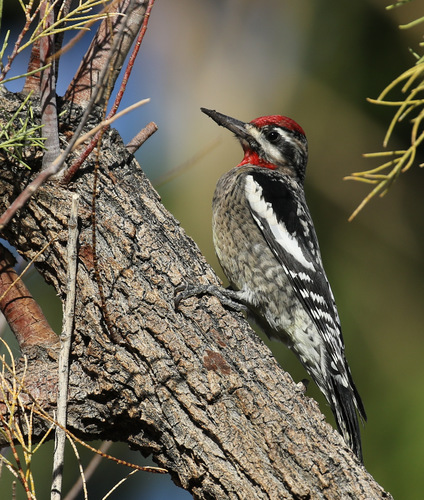
Red-naped Sapsucker
Sphyrapicus nuchalis
A master of the western woods, the Red-naped Sapsucker is a colorful architect that carves elaborate sap wells to sustain itself and its forest neighbors.
Quick Identification
Size
Length: 19–21 cm (7.5–8.3 in); Wingspan: 41–43 cm (16–17 in); Weight: 32–55 g (1.1–1.9 oz)
Colors
Black and white barred back, red crown and nape; males have a full red throat while females typically have a white patch on the lower throat. Distinctive yellowish wash on the belly.
Key Features
- Distinct red patch on the nape (back of the neck)
- Neat horizontal rows of sap wells drilled into tree trunks
- Vertical white wing stripe visible when perched
- Red throat bordered by a black 'frame'
When You’ll See Them
Geographic range
Where Does the Red-naped Sapsucker Live?
Native to the interior regions of Western North America, the Red-naped Sapsucker is a classic species of the Rocky Mountains and the Great Basin. Its breeding grounds extend from central British Columbia and Alberta through the mountainous United States. During the winter months, these birds migrate to the southwestern U.S. and high-altitude regions of central Mexico, seeking out active sap flows and milder climates.
Basemap © OpenStreetMap contributors
Behavior
Red-naped Sapsuckers are the rhythmic 'engineers' of the forest. They are famous for drilling 'sap wells'—neat, shallow, horizontal rows of holes in tree bark. They don't just drink the sugary sap that wells up; they also consume the insects that get trapped in the sticky fluid, such as ants and wasps. This unique feeding strategy makes them a keystone species, as their abandoned wells provide food for hummingbirds, warblers, and even small mammals.
Unlike many other woodpeckers that hammer loudly into rotting wood for grubs, sapsuckers have a more delicate, tapping drumming style that often starts with a rapid burst and tapers off into an irregular rhythm. They are generally solitary but can be quite territorial around their favorite sap trees. In suburban areas, they are often seen moving hitch-like up a trunk, occasionally pausing to peek around the side of the tree to keep an eye on potential threats.
EverydayEarth exclusive
Camera Tips
To capture the best footage of a Red-naped Sapsucker, look for 'active' sap wells. These are trees with fresh, moist-looking rows of holes, often on birch, aspen, or maple. Mount your camera 5 to 8 feet high on an adjacent tree or a tripod, pointing it directly at the trunk with the wells. Because these birds spend several minutes at a time methodically licking sap, set your camera to a longer video mode (20-30 seconds) rather than high-speed stills to catch their unique feeding behavior.
Place your camera during the spring and early summer when sap is flowing most vigorously. These birds are most active in the early morning as the sun begins to warm the trees. If you are trying to attract them in a backyard setting, place a suet feeder with a 'tail-prop' (an extended bottom piece) near a tree trunk. Sapsuckers feel much more comfortable feeding when they can brace their tails against a flat surface, just as they do on a tree.
Lighting is key for identification; try to position the camera so the sun is behind it. This will highlight the red nape and the yellow belly wash, which can look dull or grey in deep shade. Avoid high-traffic areas, as sapsuckers can be flighty; a quiet corner of the yard with mature trees is the ideal spot for a trail camera setup.
Similar Species
Species that look similar or are commonly confused with Red-naped Sapsucker.
Frequently Asked Questions
Record Red-naped Sapsucker at your habitat
Connect a camera to start building your own species record — AI identifies every visitor automatically.