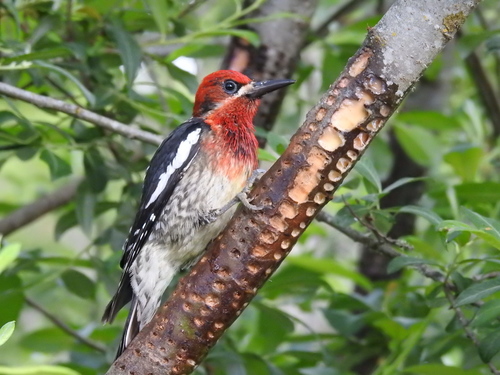
Red-breasted Sapsucker
Sphyrapicus ruber
With its vibrant crimson head and unique 'sap-farming' lifestyle, the Red-breasted Sapsucker is one of the West Coast's most charismatic forest dwellers. Discover how to spot their signature bark patterns and capture their bold colors on your backyard camera.
Quick Identification
Size
Length: 20-22 cm (8-8.7 in); Wingspan: 37-40 cm (14.5-16 in); Weight: 39-68 g (1.4-2.4 oz)
Colors
Brilliant crimson-red head and breast; black upperparts with white mottling; large, prominent white wing patch; pale yellowish-white belly. Males and females look nearly identical.
Key Features
- Vivid red head and chest without black borders
- Large, elongated white patch on the wing coverts
- Horizontal rows of small, square 'sap wells' in tree bark
- Sturdy, chisel-like bill for drilling
When You’ll See Them
Geographic range
Where Does the Red-breasted Sapsucker Live?
This striking woodpecker is a true West Coast specialist, native to the Pacific Northwest and coastal regions of North America. Its primary range extends from the lush, temperate rainforests of Southeast Alaska and British Columbia southward through Washington and Oregon, reaching deep into the mountain ranges and coastal woods of California. While primarily found in these western states and provinces, some populations are found in the northern parts of Baja California, Mexico, during the winter months as they seek milder climates.
Basemap © OpenStreetMap contributors
Behavior
The Red-breasted Sapsucker is famous for its specialized feeding strategy: it drills neat, horizontal rows of shallow holes, known as sap wells, into the bark of living trees. These birds spend much of their day maintaining these wells, returning frequently to lap up the sugary sap with their brush-tipped tongues and to snack on the ants, wasps, and flies that get stuck in the sticky fluid.
Unlike many other woodpeckers that have a rhythmic, machine-gun-like drum, the sapsucker’s drumming is irregular and staccato, often sounding like someone tapping out a slow, halting rhythm. They are generally solitary outside of the breeding season but can be quite territorial over a productive set of sap wells, occasionally chasing away other birds or even small mammals like squirrels that try to steal their sap.
In suburban settings, they are often less shy than other woodpeckers, sometimes choosing trees very close to homes or patios. While they are usually quiet, their presence is often announced by their 'meew' call, which sounds remarkably like a cat's meow or a crying baby, typically delivered from high within the canopy.
EverydayEarth exclusive
Camera Tips
To capture the Red-breasted Sapsucker, you need to look for their 'calling card' before setting your camera. Scan the trunks of birch, maple, hemlock, or pine trees for horizontal rows of small, square holes. Once you find an active set of sap wells—identifiable by fresh sap weeping from the holes—mount your camera on a nearby tree or post. Aim the lens directly at the wells from about 5 to 8 feet away for the best detail.
Since sapsuckers spend significant time clinging vertically to trunks, mount your camera at eye level (roughly 5-6 feet high) rather than low to the ground. A slight upward angle can help capture the vibrant red of their throat and chest. If you are using a trail camera, ensure the 'trigger speed' is set to its fastest setting, as these birds can be flighty, though they tend to linger longer than other woodpeckers once they begin feeding at a well.
While sapsuckers are less likely to visit standard seed feeders, they are highly attracted to suet and high-energy fruit blocks. Placing a suet cage near an active sap well is a surefire way to get them into frame. During the winter, they may also visit bird baths for water, so positioning a camera near a heated bird bath in colder climates can yield excellent results.
For the most vivid colors, aim for the morning hours between 8 AM and 11 AM when the light is bright but not overly harsh. If your camera allows for video, set it to 10-20 second clips; watching a sapsucker meticulously maintain its wells and lap up sap provides far more interesting behavioral data than a still photo alone.
Similar Species
Species that look similar or are commonly confused with Red-breasted Sapsucker.
Red-naped Sapsucker
Has a black-and-white striped face and a black 'shield' on the chest, whereas the Red-breasted is almost entirely red in those areas.
Yellow-bellied Sapsucker
Found primarily in the East; features much more black and white on the head and a distinct black crescent on the breast.
Northern Flicker
Much larger with a tan face and black-spotted belly; lacks the solid red head and white wing patch.
Frequently Asked Questions
Record Red-breasted Sapsucker at your habitat
Connect a camera to start building your own species record — AI identifies every visitor automatically.