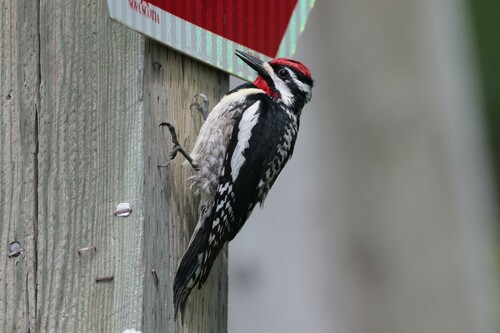
Yellow-bellied Sapsucker
Sphyrapicus varius
Master forest engineers, Yellow-bellied Sapsuckers create intricate 'sap wells' that feed a whole host of backyard wildlife. Spot them by their vertical wing stripes and rhythmic, stuttering drum.
Quick Identification
Size
Length: 7.1–8.7 in (18–22 cm); Wingspan: 13.4–15.7 in (34–40 cm); Weight: 1.5–1.9 oz (43–55 g)
Colors
Mottled black and white back, pale yellow wash on the belly. Both sexes have a bright red forehead; males have a red throat while females have a white throat.
Key Features
- Prominent vertical white stripe along the folded wing
- Bright red forehead patch
- Neat, horizontal rows of small holes (sap wells) in tree bark
- Erratic, stuttering drumming rhythm
When You’ll See Them
Geographic range
Where Does the Yellow-bellied Sapsucker Live?
This North American native breeds across a vast northern belt stretching from the boreal forests of Canada and Alaska through the northeastern United States. As winter approaches, they migrate southward, making them a common sight across the southeastern United States, Mexico, and Central America, reaching as far south as Panama. This wide migratory path means they are seasonal visitors to many backyard birders throughout the mid-latitudes of the continent.
Basemap © OpenStreetMap contributors
Behavior
The Yellow-bellied Sapsucker is a specialized woodpecker known for its unique engineering skills. Unlike most woodpeckers that drum into wood to find hidden larvae, the sapsucker drills neat, shallow wells into the bark of live trees. They feed on the nutrient-rich sap that oozes out and the small insects that get trapped in the sticky liquid. This behavior makes them a 'keystone species,' as their wells provide a vital food source for hummingbirds, bats, and other insects.
These birds are less social than some other woodpeckers and are often found alone or in pairs. They are highly migratory, which is unusual for North American woodpeckers, moving from northern forests to the southern U.S. and Central America for the winter. When communicating, their drumming is distinctive; it starts with a few rapid taps followed by a slowing, irregular series of beats that sounds almost like a person rhythmically tapping a pencil.
EverydayEarth exclusive
Camera Tips
To capture the Yellow-bellied Sapsucker, the best strategy is to locate their 'signature' work. Look for trees in your yard with rows of small, horizontal holes. These are active sap wells. Mount your camera 5 to 7 feet high on a nearby tree or on a tripod aimed directly at these holes. Because sapsuckers spend significant time 'tending' their wells, you can capture excellent long-form video of their specialized feeding behavior.
If you don't have active sap wells, you can attract them with suet feeders, particularly those with a tail prop. Sapsuckers are also fond of fruit; placing a platform feeder with halved oranges or berries during the spring and fall migration windows can lure them into view. Position your camera at a 45-degree angle to the feeder to ensure you capture the white wing stripe and the throat color, which is essential for identifying the sex of the bird.
Since sapsuckers are diurnal, focus your recording schedule on the early morning hours when they are most active. Use a high-speed shutter setting if possible, as their head movements while drilling are incredibly fast. In the winter, providing a heated birdbath can be a major draw, as they need reliable water sources to supplement their sticky, sugar-heavy diet.
Similar Species
Species that look similar or are commonly confused with Yellow-bellied Sapsucker.
Downy Woodpecker
Smaller with a shorter beak; lacks the sapsucker's yellow belly and the vertical white wing stripe.
Red-naped Sapsucker
Very similar but found in Western North America; usually features a red patch on the back of the head (nape) which the Yellow-bellied lacks.
Hairy Woodpecker
Larger than a Downy but lacks the red forehead and yellow belly of the sapsucker.
Frequently Asked Questions
Record Yellow-bellied Sapsucker at your habitat
Connect a camera to start building your own species record — AI identifies every visitor automatically.