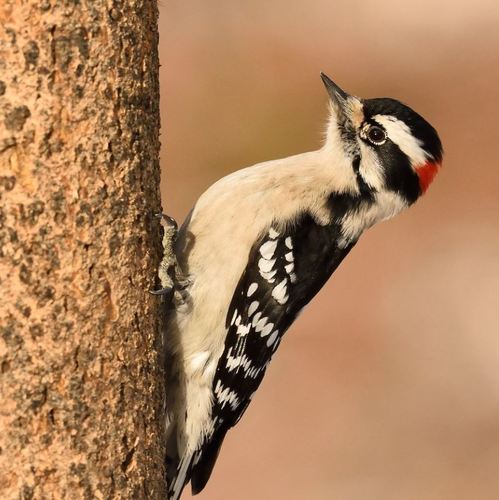
Downy Woodpecker
Dryobates pubescens
Meet the smallest and most energetic woodpecker in North America. A frequent visitor to backyard feeders, the Downy Woodpecker is a black-and-white marvel known for its acrobatic foraging and friendly disposition.
Quick Identification
Size
Length: 5.5-6.7 in (14-17 cm); Wingspan: 9.8-11.8 in (25-30 cm); Weight: 0.7-1.1 oz (21-33 g)
Colors
Checkered black and white wings, white underparts, and a bold white stripe down the center of the back. Males have a small red patch on the back of the head.
Key Features
- Smallest North American woodpecker
- Chisel-like bill is notably shorter than the length of the head
- White outer tail feathers often have subtle black spots
- Acrobatic movement on small branches and weed stalks
When You’ll See Them
Sightings on EverydayEarth
May 11, 2026
A male Downy Woodpecker lands on the feeder tray, probes through the seeds for a few seconds, and then quickly flies off into the yard.
Aug 2, 2026
A busy scene at the feeders with several species present at once. A Mourning Dove feeds calmly in the central tray while a Downy Woodpecker works on the suet feeder to the left. On the right side, multiple male Red-winged Blackbirds and a Brown-headed Cowbird take turns at the tube feeder, with frequent flying and hopping as they compete for space.
Aug 2, 2026
An active early morning at the feeders. A male Downy Woodpecker is perched on the suet log to the left, while a Mourning Dove feeds on the tray below. In the background, a Black-capped Chickadee flits onto a tube feeder to grab a seed.
Aug 1, 2026
A busy afternoon at the feeding station with several species active at once. A male Red-winged Blackbird with bright red and yellow shoulder patches feeds in the large tray alongside two heavily streaked females or juveniles. A Downy Woodpecker is perched on the central wooden post, and a House Finch is visible on the hanging tube feeder to the left.
Aug 1, 2026
The scene is active with several birds visiting the feeder station. A male Downy Woodpecker is initially perched on the center feeder before departing. Shortly after, two Common Grackles land on the main tray to forage. A Brown-headed Cowbird is also seen feeding on the log-style suet feeder on the left, while another grackle perches above the station.
Aug 1, 2026
The video captures a busy morning at the feeder. A Downy Woodpecker is seen clinging to the suet feeder on the left, while a White-throated Sparrow and a Common Grackle forage on the main seed tray. Around the seven-second mark, a Blue Jay swoops in and lands on the tray, causing the other birds to depart. The Blue Jay then begins to sift through the seeds.
Geographic range
Where Does the Downy Woodpecker Live?
The Downy Woodpecker is native to North America, boasting an expansive range that covers most of the continent. They are year-round residents from the boreal forests of Alaska and Canada all the way south to the Gulf Coast of the United States. While they avoid the arid deserts of the Southwest and the treeless northern tundra, they thrive in almost every other wooded or suburban environment in between.
Basemap © OpenStreetMap contributors
Recorded on EverydayEarth
Behavior
The Downy Woodpecker is a lively and acrobatic bird, often seen hitching up tree trunks or balancing on slender branches that larger woodpeckers can't reach. They are surprisingly social for woodpeckers, frequently joining mixed-species foraging flocks with chickadees and nuthatches during the winter months. This 'safety in numbers' approach allows them to spend less time scanning for predators and more time hunting for food.
In suburban settings, they are among the most frequent visitors to bird feeders, showing little fear of humans. Their presence is often announced by a sharp, high-pitched 'pick' call or a rapid, descending whinny. During the spring, you’ll hear their rhythmic drumming as they hammer on resonant wood or even metal gutters to establish territory and attract a mate.
EverydayEarth exclusive
Camera Tips
To capture high-quality footage of a Downy Woodpecker, the most effective strategy is to aim your camera at a suet feeder. Position the camera approximately 3 to 5 feet away to get a detailed view of their intricate plumage. Because Downies are small, a slightly upward angle from a lower mounting point on a post or tree can make the bird appear more prominent in the frame. Ensure the background is somewhat distant to create a soft 'bokeh' effect that makes the black-and-white bird pop.
Lighting is crucial for capturing the fine details of their feathers. North-facing setups often provide the most consistent, indirect light, preventing harsh shadows or blown-out highlights on their white patches. If you are placing a camera on a natural tree trunk instead of a feeder, look for dead branches or 'snags' where you see existing drill holes; these are favorite foraging spots. Mount your camera at eye level, roughly 5-6 feet high, for the most natural perspective.
Regarding camera settings, a fast trigger speed is essential as these birds move their heads with incredible rapidity. If your AI camera allows for video, set it to 60fps to smooth out their jerky movements. During winter, Downies are even more active at feeders, making it the prime season for backyard photography. To attract them specifically, offer high-energy suet or peanut butter plugs in a dedicated woodpecker feeder with a tail-prop base, which allows them to stabilize themselves while feeding.
Similar Species
Species that look similar or are commonly confused with Downy Woodpecker.
Frequently Asked Questions
Record Downy Woodpecker at your habitat
Connect a camera to start building your own species record — AI identifies every visitor automatically.