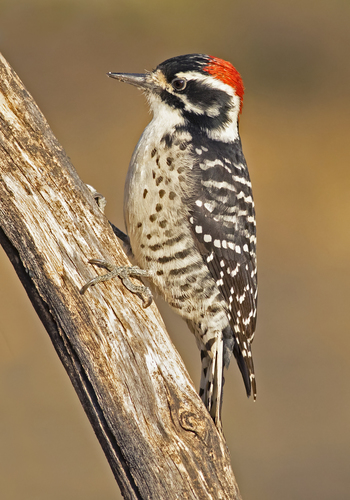
Nuttall's Woodpecker
Dryobates nuttallii
The quintessential spirit of the California oaks, the Nuttall's Woodpecker is a master of bark-gleaning and acrobatic foraging. With its striking ladder-patterned back and energetic 'pit-it' call, it is a prized visitor for any West Coast backyard.
Quick Identification
Size
Length: 6.3–7.1 in (16–18 cm); Wingspan: 13–16 in (33–41 cm); Weight: 1.1–1.6 oz (30–45 g)
Colors
Black and white horizontal 'ladder' bars on the back. Underparts are white with black spotting on the flanks. Males feature a bright red patch on the back of the head, while females have a plain black crown.
Key Features
- Horizontal black and white 'ladder' stripes on the back
- Red patch on the rear of the crown (males only)
- Relatively small, straight bill
- White face with two distinct black cheek stripes
When You’ll See Them
Behavior
Nuttall's Woodpeckers are energetic and highly specialized birds, almost exclusively tied to the oak woodlands of California. They are frequently observed 'hitching' up tree trunks and along the undersides of branches in a characteristic jerky motion. Unlike some larger woodpecker species, Nuttall's are quite acrobatic, often hanging upside down from thin twigs to glean insects that other birds might miss.
These birds are year-round residents and are highly territorial. While they aren't as loud as the Northern Flicker, they communicate with a sharp, rattling call and a distinctive 'pit-it' note. In a backyard setting, they are shy but curious; they may spend several minutes observing a feeder from a nearby branch before committing to a landing. They are solitary for most of the year but form strong pair bonds during the spring nesting season.
EverydayEarth exclusive
Camera Tips
To capture the best footage of a Nuttall's Woodpecker, position your camera vertically on the trunk of a mature tree, ideally an oak or a sycamore. These birds are 'hitchers,' meaning they move upward in a straight or spiral path. Mount your camera at eye level (about 5 to 6 feet high) and use a slight downward tilt. This angle ensures you catch the bird’s facial markings and the male's red nape as they pause to inspect the bark for insects.
If you are looking to draw them into a specific frame, suet is your best friend. Instead of a hanging cage that swings, use a 'tail-prop' suet feeder mounted directly to the tree or a flat surface. This mimics their natural feeding posture and keeps them stationary long enough for your AI camera to trigger a high-quality capture. High-fat suet with nuts or mealworms is particularly effective during the cooler winter months when natural insect activity is lower.
Lighting is the difference between a blurry silhouette and a gallery-worthy shot. Because Nuttall's Woodpeckers have high-contrast black and white feathers, direct afternoon sun can 'blow out' the white bars. Aim for a spot that receives bright, filtered morning light. If your camera allows for sensitivity adjustments, set a fast trigger speed. These birds are notorious for rapid head movements while drumming or foraging, which can cause motion blur on standard settings.
In the spring, keep an eye out for 'excavation' behavior. If you see a Nuttall's Woodpecker repeatedly visiting a dead limb, place a camera about 15 feet away facing that branch. You might capture the fascinating process of cavity nesting, from the initial drilling to the parents bringing food to the chicks. Just ensure you never place the camera close enough to disturb their nesting process, as they can be sensitive to new objects near their home.
Similar Species
Species that look similar or are commonly confused with Nuttall's Woodpecker.
Ladder-backed Woodpecker
Nearly identical, but found in desert scrub rather than oak woodlands; the male's red cap extends further forward toward the forehead.
Downy Woodpecker
Smaller with a shorter bill and a solid white patch on the back instead of horizontal bars.
Hairy Woodpecker
Significantly larger with a much heavier, longer bill and a solid white back.
Frequently Asked Questions
Record Nuttall's Woodpecker at your habitat
Connect a camera to start building your own species record — AI identifies every visitor automatically.