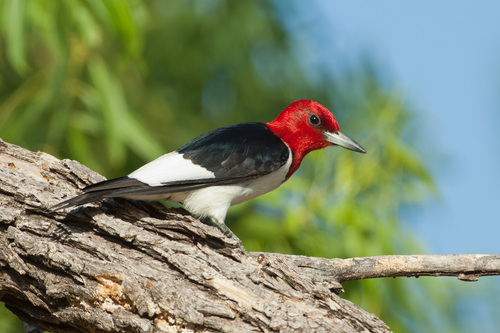
Red-headed Woodpecker
Melanerpes erythrocephalus
Often called the 'flying checkerboard,' the Red-headed Woodpecker is a bold and charismatic showstopper. With its completely crimson head and striking white wing patches, it is perhaps the most easily recognized and stunning visitor to the American backyard.
Quick Identification
Size
Length: 7.5-9.1 in (19-23 cm); Wingspan: 16.5 in (42 cm); Weight: 2.0-3.2 oz (56-91 g)
Colors
Brilliant, solid crimson head and neck; snow-white underparts; black back with massive white patches on the wings. Adults are monomorphic (males and females look identical).
Key Features
- Entire head, neck, and throat are a uniform deep red
- Large, square white patches on the inner trailing edge of the wings
- Solid black upper back and tail contrasting with a pure white belly
- Powerful, light gray chisel-shaped bill
When You’ll See Them
Behavior
The Red-headed Woodpecker is an exceptionally bold and active bird, often referred to by birders as the 'flying checkerboard' due to its striking plumage. Unlike many other woodpecker species that spend most of their time spiraling up tree trunks to peck for larvae, this species is a master of aerial acrobatics. It frequently perches on high branches or fence posts to launch into the air and snatch flying insects, a behavior known as 'fly-catching.'
These birds are also highly social and notoriously territorial. They are one of the few woodpecker species known to cache, or store, food for later use. They will wedge acorns, beech nuts, and even live grasshoppers into deep crevices in bark or under shingles, often covering the cache with wood chips to hide it from competitors. They are loud and vocal, using a series of 'queeah' calls to defend their territory from intruders.
EverydayEarth exclusive
Camera Tips
To capture the best footage of a Red-headed Woodpecker, placement is everything. These birds are drawn to 'snags'—standing dead trees—which they use for both nesting and as percussion instruments for drumming. Position your AI-powered camera 10 to 15 feet high on a tree trunk or a sturdy pole, facing a known snag or a large horizontal limb where they are likely to land and scan for insects. Ensure the camera has a clear line of sight, as these birds are fast fliers and you want to catch them before they duck behind a branch.
If you are using a backyard feeder to attract them, suet and whole peanuts are the most effective lures. Place a suet cage on a dedicated pole or a mature oak tree. Because Red-headed Woodpeckers have a lot of white in their plumage, they can easily appear 'washed out' or overexposed in direct, midday sun. Try to position your camera facing north or south to avoid the harsh glare of the rising or setting sun, and if your camera allows for exposure adjustment, a slight negative compensation can help preserve the detail in their white wing patches.
During the autumn months, focus your camera on potential 'granary' sites. Look for deep furrows in tree bark or gaps in wooden fence posts where you see the bird repeatedly returning. Setting your camera to 'Burst Mode' or a high-frame-rate video setting is essential; their movements are incredibly twitchy and rapid, especially when they are shoving nuts into crevices. A fast trigger speed is required to capture the moment they transition from their iconic black-and-white profile to the full flash of white during a take-off.
Similar Species
Species that look similar or are commonly confused with Red-headed Woodpecker.
Red-bellied Woodpecker
The Red-bellied has a striped 'zebra' back and only a partial red cap, whereas the Red-headed has a completely solid red head and large white wing blocks.
Northern Flicker
Flickers are brownish with black spots and a black chest crescent, lacking the vivid solid red head of the Red-headed Woodpecker.
Frequently Asked Questions
Record Red-headed Woodpecker at your habitat
Connect a camera to start building your own species record — AI identifies every visitor automatically.