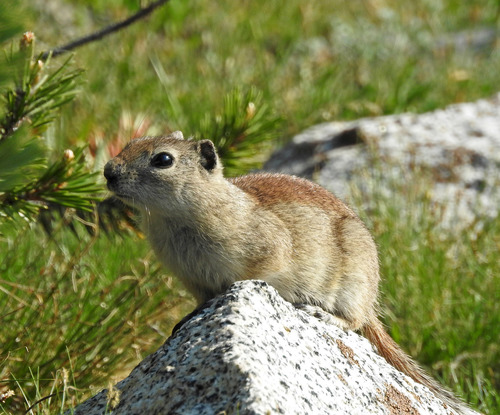
Belding's Ground Squirrel
Urocitellus beldingi
Famous for their 'picket-pin' posture and piercing alarm calls, these social mountain residents are the sentries of the high meadows.
Quick Identification
Size
Length 23-30 cm (9-12 in); Weight 230-500 g (8-18 oz)
Colors
Grayish-brown coat with a subtle reddish-brown wash on the back; buff-colored underside; tail is reddish underneath with a black tip.
Key Features
- Distinctive 'picket-pin' upright standing posture
- Short tail with a reddish underside
- Small, rounded ears and large dark eyes
- Stocky, brownish-gray body
When You’ll See Them
Geographic range
Where Does the Belding's Ground Squirrel Live?
Native to the high-country regions of the Western United States, Belding's ground squirrel is a staple of the Great Basin and Sierra Nevada ecosystems. Its core range encompasses northeastern California, eastern Oregon, and southwestern Idaho, extending into northern Nevada and northwestern Utah. This species is most frequently encountered in protected mountain parks and alpine meadows where the soil is suitable for deep burrowing.
Basemap © OpenStreetMap contributors
Behavior
Belding's ground squirrels are highly social and are best known for their vigilant sentry behavior. They frequently stand perfectly upright on their hind legs—a pose known as the 'picket-pin'—to scan the horizon for predators such as hawks, coyotes, or badgers. When a threat is spotted, they emit a sharp, high-pitched whistle to warn their colony, which typically consists of related females and their offspring.
These squirrels are true seasonal specialists, spending up to eight months of the year in deep hibernation to survive the harsh mountain winters. They emerge in late spring as the snow melts, engaging in a frantic period of mating and foraging. Because their active window is so short, they are exceptionally busy during the summer months, spending nearly all their daylight hours feeding or sunbathing near their burrow entrances.
EverydayEarth exclusive
Camera Tips
Capturing the perfect shot of a Belding's ground squirrel requires low-profile camera placement. Mount your camera just 6 to 12 inches above the ground, ideally on a small tripod or stake. Position the lens to overlook a clear patch of ground near a burrow entrance or a well-used 'runway' through the meadow grass. Because they are low to the ground, a downward-tilted angle works best to capture their facial features and the reddish tones of their fur.
The 'picket-pin' pose is their most iconic behavior, and you can encourage this by placing your camera in an area with a clear view of the surroundings. If they feel safe but need to scan for distant sounds, they are more likely to stand tall. Avoid placing cameras in thick brush where they feel vulnerable; instead, focus on the edges where meadow meets rocky outcroppings or sagebrush. These squirrels are most active during mid-morning and late afternoon when the mountain sun isn't at its peak intensity.
Since these rodents are only active for a few months a year, timing is critical. Deploy your gear as soon as the snow melts in late May or June. High-speed trigger settings are essential, as their movements are quick and jerky. If you are using a trail camera with video capability, set it to short 10-15 second clips; this is often enough to capture their social interactions or the moment they emit an alarm whistle. Make sure your camera has a high-quality PIR sensor, as their small body heat signature can sometimes be difficult to detect against a warm, sun-baked rock.
Similar Species
Species that look similar or are commonly confused with Belding's Ground Squirrel.
Frequently Asked Questions
Record Belding's Ground Squirrel at your habitat
Connect a camera to start building your own species record — AI identifies every visitor automatically.