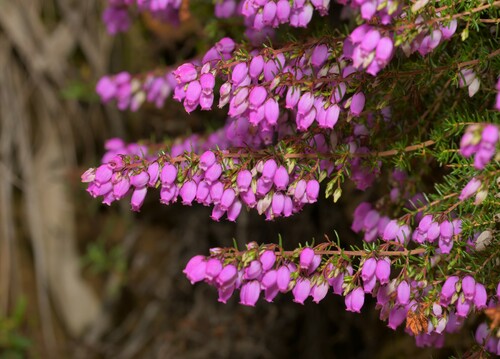
Bell Heather
Erica cinerea
The vibrant purple heartbeat of the heathlands, Bell Heather is a resilient beauty that thrives where few others can. This evergreen shrub is an essential haven for bumblebees and a stunning subject for any backyard camera.
Quick Identification
Size
15–60 cm (6–24 inches) in height with a similar spread
Colors
Vibrant magenta to dark purple bell-shaped flowers; dark, waxy green needle-like foliage
Key Features
- Bell-shaped flowers in terminal clusters
- Needle-like leaves arranged in whorls of three
- Dark green, hairless stems
- Compact, bushy evergreen shrub habit
When You’ll See Them
Geographic range
Where Does the Bell Heather Live?
Bell Heather is a hallmark of the Atlantic fringe of Europe, thriving in the cool, humid maritime climates of the continent's western edge. Its most dense populations are found across the United Kingdom and Ireland, where it paints vast landscapes of moorland and hillside in purple. Its native range extends from the coastal regions of Norway southward through the Atlantic-facing parts of France, Spain, and Portugal, occasionally reaching inland to parts of Germany and Northern Italy in suitable acidic pockets.
Basemap © OpenStreetMap contributors
Behavior
Ecologically, this plant serves as a vital 'filling station' for pollinators. Because its bell-shaped flowers protect nectar from rain, it is a reliable food source for long-tongued bees and butterflies even in damp weather. It exhibits a symbiotic relationship with honeybees and bumblebees, which are the primary visitors responsible for its pollination.
Though it remains stationary, Bell Heather is a master of environmental adaptation. Its waxy, needle-like leaves are designed to minimize water loss, allowing it to survive on wind-swept coastal cliffs and well-drained rocky slopes. It grows relatively slowly but forms dense, woody mats that provide shelter for small ground-dwelling insects and reptiles.
EverydayEarth exclusive
Camera Tips
When setting up your EverydayEarth camera to capture Bell Heather, the goal is often to document the incredible variety of pollinators it attracts. Position your camera on a low-profile tripod or ground mount, ideally 20–30 cm (8–12 inches) from a healthy cluster of blooms. An angled-upward shot often captures the 'bells' more clearly against the sky or distant foliage, providing a professional-looking bokeh effect.
Because plants don't move, use this as an opportunity to master your camera's macro or close-focus settings. If your AI camera has a 'pet' or 'small animal' trigger mode, it may be sensitive enough to capture the bees and butterflies that visit the plant. To 'bait' your camera, ensure the heather is in a sunny spot; pollinators are most active on Bell Heather when the sun hits the flowers, warming the nectar and increasing its scent profile.
Early morning light (the 'Golden Hour') is particularly flattering for the deep magenta hues of Bell Heather, which can sometimes appear washed out in harsh midday sun. If your camera supports time-lapse mode, this is a fantastic species for a long-term project. Set a frame to trigger once every few days from May through July to watch the buds swell and transform into a sea of purple. Ensure the area around the plant is clear of tall swaying grasses that might cause false triggers on windy days.
Similar Species
Species that look similar or are commonly confused with Bell Heather.
Frequently Asked Questions
Record Bell Heather at your habitat
Connect a camera to start building your own species record — AI identifies every visitor automatically.