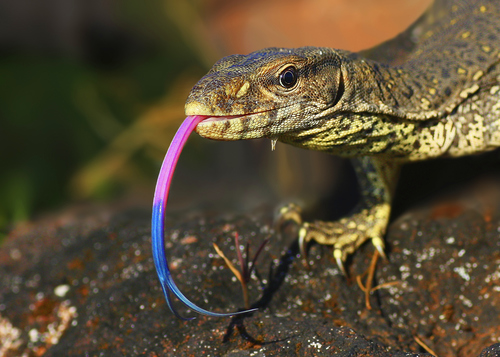
Bengal Monitor
Varanus bengalensis
The Bengal monitor is the undisputed king of the backyard reptilian world. This intelligent, powerful predator is as comfortable climbing trees as it is patrolling garden walls, making it a spectacular species to discover on your home camera.
Quick Identification
Size
Total length up to 175 cm (5.7 ft); weight typically ranges from 3 to 7.2 kg (6.6 to 15.8 lbs)
Colors
Dull grey, olive, or brown above with darker crossbands; juveniles are brighter with yellow spots that fade with maturity
Key Features
- Heavy-set body with a long, laterally compressed tail
- Long, deeply forked tongue used for chemoreception
- Slit-like nostrils positioned midway between the eye and snout
- Strong, curved claws adapted for digging and climbing
When You’ll See Them
Geographic range
Where Does the Bengal Monitor Live?
Native to the vast landscapes of Southern Asia, the Bengal monitor boasts one of the widest distributions of any monitor lizard. Its core range extends across the entire Indian subcontinent, including India, Pakistan, Sri Lanka, Bangladesh, and Nepal. It also reaches westward into the arid regions of southeastern Iran and Afghanistan, and eastward into Southeast Asia through Myanmar and into parts of Thailand and Vietnam, successfully inhabiting everything from dry deserts to humid tropical fringes.
Basemap © OpenStreetMap contributors
Behavior
The Bengal monitor is a primarily solitary and diurnal reptile, spending its mornings basking in the sun to regulate its body temperature before beginning a day of active hunting. These monitors are incredibly versatile; they are equally comfortable sprinting across open ground, climbing high into trees to raid bird nests, or swimming across bodies of water. When threatened, they typically seek cover in burrows, hollow logs, or thick vegetation, but if cornered, they can defend themselves vigorously by hissing, inflating their throats, and delivering powerful lashes with their tails.
While they are apex predators in many of their micro-habitats, Bengal monitors are generally shy and wary of human presence. In suburban or rural areas, they often adapt to the presence of people, frequently scavenging near farms or gardens. They are known for their high intelligence among reptiles, displaying complex foraging strategies and the ability to remember specific locations where food is consistently found.
EverydayEarth exclusive
Camera Tips
To capture high-quality footage of a Bengal monitor, camera placement is everything. These lizards are low-slung, so mount your camera no higher than 12 to 18 inches off the ground. Aiming the lens at a 45-degree angle across a known game trail or the edge of a wall or fence is more effective than a straight-on shot, as it gives the AI more time to trigger and capture the full length of the animal's body and tail.
Focus your efforts on 'basking hotspots.' Look for flat rocks, fallen logs, or patches of bare earth that receive direct morning sunlight. Bengal monitors must heat up before they can hunt effectively, and they will often spend 20-30 minutes stationary in these spots, providing the perfect opportunity for clear, high-resolution photos. If you are in a suburban area, placing a camera near a compost heap or a woodpile can also be highly productive, as these attract the insects and rodents the monitors prey upon.
While we generally don't recommend feeding wildlife, you can use scent-based lures to pique their curiosity. A small amount of oily fish or a cracked egg placed in a perforated container (to prevent them from eating it and moving on too quickly) will often cause a monitor to linger in front of the camera, flicking its tongue and providing excellent behavioral footage. Set your camera to 'Burst Mode' or short video clips, as their movements can be deceptively fast once they finish basking.
Similar Species
Species that look similar or are commonly confused with Bengal Monitor.
Frequently Asked Questions
Record Bengal Monitor at your habitat
Connect a camera to start building your own species record — AI identifies every visitor automatically.