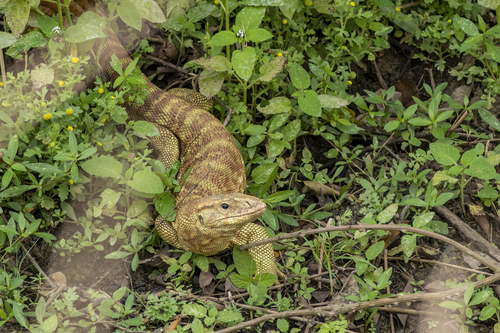
Yellow Monitor
Varanus flavescens
Glowing with a distinctive golden hue, the Yellow Monitor is a master of the South Asian wetlands. This endangered lizard is a rare and beautiful sight, perfectly adapted for a life between the land and the water.
Quick Identification
Size
Total length of 60–100 cm (24–40 in); weight ranges from 500g to 1.5kg (1.1–3.3 lbs)
Colors
Yellowish to olive-brown upper body with irregular dark cross-bands; vibrant golden-yellow or orange on the belly and throat
Key Features
- Short, rounded snout
- Slit-like nostrils positioned closer to the tip of the snout than the eye
- Vivid golden-yellow belly markings
- Tail is laterally compressed for efficient swimming
When You’ll See Them
Geographic range
Where Does the Yellow Monitor Live?
The Yellow Monitor is a specialist of the South Asian subcontinent, primarily inhabiting the fertile floodplains of the Indo-Gangetic system. Its native range spans across northern India, Bangladesh, and Nepal, with localized populations found in Pakistan and parts of Bhutan. It thrives in low-lying, water-rich environments where the land meets riverine ecosystems, making it a quintessential species of the region's great river basins.
Basemap © OpenStreetMap contributors
Behavior
Yellow Monitors are primarily diurnal reptiles that spend their mornings basking in the sun to regulate their body temperature. They are semi-aquatic and highly proficient swimmers, often seen navigating marshes or small streams. Unlike some of their larger relatives, they are relatively shy and prefer to escape into deep burrows or thick vegetation when they sense a threat.
These lizards are solitary by nature and show a high degree of seasonal activity. During the monsoon and post-monsoon months, they are most active as they forage for food and seek mates. In the cooler winter months, they undergo a period of brumation, retreating into underground burrows or mud banks where they remain inactive until the warmth returns.
While they generally avoid humans, Yellow Monitors are frequently found near rural settlements and agricultural areas. They are beneficial to farmers because they hunt pests like rodents and large insects, though they are often misunderstood and occasionally persecuted due to local myths regarding their toxicity, despite being non-venomous to humans.
EverydayEarth exclusive
Camera Tips
To successfully capture a Yellow Monitor on camera, you need to think like a semi-aquatic reptile. Position your camera at a very low angle, roughly 6 to 10 inches off the ground, aiming toward sun-drenched mudflats or the edges of marshy ponds. These lizards rely on the morning sun to jumpstart their metabolism, so east-facing setups that catch the first light on a basking log or flat rock are ideal for early-day sightings.
Since these monitors have a keen sense of smell, you can use scent-based lures to draw them into the camera's field of view without needing a food reward. A small piece of cloth soaked in fish oil or a securely placed, punctured tin of sardines can entice them to linger and investigate. Their forked tongues will likely be out and flickering as they process the scent, which makes for a dynamic and fascinating photograph.
Timing is critical when tracking this species. They are almost entirely inactive during the dry, cold winter months, so your best results will occur during the monsoon and immediate post-monsoon season (June through October). During this time, the ground is soft, and you can look for 'drag marks' from their tails in the mud as a sign of where to place your equipment. High-humidity environments can fog lenses, so ensure your camera housing is well-sealed and consider using anti-fog inserts.
Set your camera to a multi-shot burst or a high-definition video mode. Yellow Monitors move with a distinctive, swaying gait, and a single still photo often fails to capture their unique movement pattern. A 15-second video clip of a monitor emerging from a burrow or swimming across a shallow pool provides much better data for identification and behavior study than a single frame.
Similar Species
Species that look similar or are commonly confused with Yellow Monitor.
Frequently Asked Questions
Record Yellow Monitor at your habitat
Connect a camera to start building your own species record — AI identifies every visitor automatically.