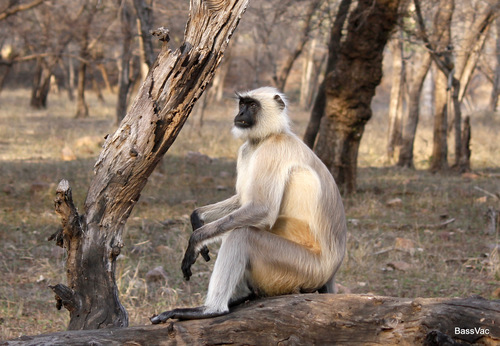
Bengal Sacred Langur
Semnopithecus entellus
Revered for centuries and recognizable by its striking black face and silvery coat, the Bengal Sacred Langur is an iconic presence in the Indian landscape. Whether leaping through temple ruins or lounging in suburban gardens, these intelligent primates offer a fascinating glimpse into the world of wild monkeys living alongside humans.
Quick Identification
Size
Head-body length of 50–75 cm (20–30 in) with a tail reaching 70–100 cm (28–40 in); weight ranges from 11–18 kg (24–40 lbs).
Colors
Silvery-gray to light buff body fur; distinctive hairless jet-black face and ears; pale cream or white underparts.
Key Features
- Striking jet-black face and ears
- Long, slender tail usually held in a high arch
- Silvery-gray coat with a forward-pointing brow ridge of hair
- Lanky, athletic build with long limbs
When You’ll See Them
Geographic range
Where Does the Bengal Sacred Langur Live?
Native to the vast and diverse landscapes of South Asia, the Bengal Sacred Langur is most prominently found across the northern plains of India, stretching from the foothills of the Himalayas down through the Gangetic plains. Its range extends into the southern reaches of Nepal and westward into parts of Pakistan and eastern Bangladesh. Because they are deeply integrated into local culture and religious practices, they are frequently seen in both wild protected areas and bustling human settlements across this region.
Basemap © OpenStreetMap contributors
Behavior
The Bengal Sacred Langur is a highly social primate, typically found in troops ranging from a few individuals to over 50. They are semi-terrestrial, meaning they spend a significant amount of time on the ground compared to other monkeys, though they remain exceptionally agile climbers and leapers. Their social structure is complex, often consisting of multi-male or all-male groups, and they are known for their grooming rituals which help maintain group bonds and reduce social tension.
In many parts of their range, these langurs live in close proximity to humans, particularly around temples and urban centers where they are considered sacred and often fed by locals. While generally docile and shy in the wild, they can become quite bold and mischievous in suburban settings. They communicate through a variety of barks, grunts, and visual displays, and are most active during the daylight hours, retreating to high canopy roosts or tall buildings at night for safety.
EverydayEarth exclusive
Camera Tips
To capture the Bengal Sacred Langur on camera, position your device at a medium height, roughly 3 to 5 feet off the ground. Since these monkeys are semi-terrestrial, they frequently travel along well-worn footpaths, garden walls, or low fences. Angling the camera slightly downward across a clearing or along a boundary line will capture their distinctive loping gait and long, arched tails. Avoid placing cameras too low in high-traffic areas, as their intense curiosity might lead them to investigate, shake, or even manipulate the device.
If you are in a suburban or village setting, focus on 'travel corridors' like the tops of stone walls or low-hanging branches that bridge gaps between buildings. They are creatures of habit and often follow the same routes daily between their feeding grounds and roosting sites. While we don't recommend baiting with human food, which can lead to aggressive behavior, placing a stable water basin or birdbath in a quiet corner of your yard can be a powerful lure, especially during the dry season when natural water sources are scarce.
Use a fast shutter speed or high-quality video mode, as langurs move with surprising speed when jumping or playing. Early morning and late afternoon provide the best natural lighting to highlight the contrast between their silvery fur and jet-black faces. During the midday heat, they often lounge in the shade, so look for shaded patios or large tree canopies as potential stationary capture spots where they may spend time grooming each other.
Similar Species
Species that look similar or are commonly confused with Bengal Sacred Langur.
Frequently Asked Questions
Record Bengal Sacred Langur at your habitat
Connect a camera to start building your own species record — AI identifies every visitor automatically.