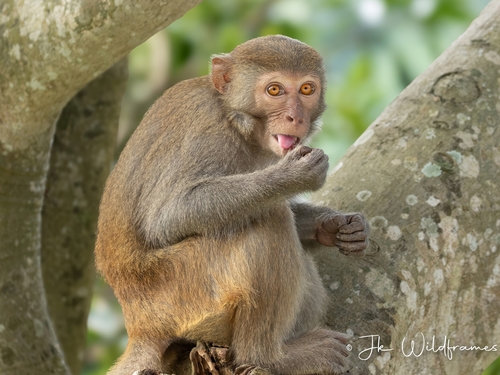
Rhesus Macaque
Macaca mulatta
Master of adaptation and social complexity, the Rhesus Macaque is a primate that thrives everywhere from the high Himalayas to the heart of bustling cities. Famous for their expressive faces and tight-knit family troops, they offer a fascinating window into the world of wild primates.
Quick Identification
Size
Length: 47–53 cm (19–21 in); Tail: 20.7–22.9 cm (8–9 in); Weight: 5.3–7.7 kg (12–17 lb)
Colors
Dull grayish-brown to golden-brown fur with paler underparts. Adults often feature a characteristic reddish-pink hue on the hairless skin of the face and rump.
Key Features
- Pinkish-red hairless face
- Medium-length tail roughly half the body length
- Stocky, powerful build
- Matrilineal social groups with complex facial expressions
When You’ll See Them
Geographic range
Where Does the Rhesus Macaque Live?
Originally native to a massive expanse of Asia, the Rhesus Macaque holds the title for the widest geographic distribution of any non-human primate. Their native territory stretches from the mountains of Afghanistan and the plains of India through to the forests of Southeast Asia and Southern China. Beyond their home continent, hardy feral populations have become a well-known fixture in the United States, specifically throughout the river systems of Florida where they were introduced in the 20th century.
Basemap © OpenStreetMap contributors
Behavior
Rhesus Macaques are intensely social primates that live in complex matrilineal troops ranging from 20 to over 200 individuals. Their society is built on a strict hierarchy where female rank is inherited from the mother. They spend a significant portion of their day engaged in social grooming, which serves as both a hygiene practice and a critical way to reinforce social bonds and de-escalate tension within the group.
As one of the most intelligent non-human primates, they exhibit high levels of problem-solving and vocal communication. In areas where they overlap with humans, they have become remarkably bold. They are known for their 'edge-species' behavior, thriving at the boundaries of different environments, which makes them equally comfortable in a remote forest canopy or on the rooftop of a suburban home. Their interactions with humans can range from wary avoidance to confident food-snatching.
EverydayEarth exclusive
Camera Tips
Capturing the Rhesus Macaque on camera requires a blend of durability and strategic positioning. Because these monkeys are terrestrial and arboreal, place your camera at a height of 3 to 5 feet on a sturdy tree trunk. This height is perfect for capturing their social interactions on the ground, such as grooming sessions or foraging. Always use a protective security box (bear box), as macaques are notoriously curious and possess the manual dexterity to pull at cables, smudge lenses, or even attempt to detach the camera from its mount.
Focus your camera on natural corridors like stone walls, garden fences, or clearings near water sources. Macaques often follow the same paths daily when moving between sleeping trees and foraging grounds. If you are in their native range, a fruiting tree such as a fig or mango is a natural magnet. However, avoid using human food as bait; this can lead to aggressive behavior and habituation that makes the monkeys a nuisance to neighbors. A simple, shallow water basin can be a much safer and highly effective attractant, especially during the dry season.
For the best shots, set your camera to a multi-shot burst mode or high-definition video. Macaque social life moves fast—infant play, territorial disputes, and grooming transitions happen in seconds. Diurnal settings are key; ensure your camera is positioned to avoid direct lens flare during the morning and afternoon peaks when activity is highest. If your camera supports it, a fast trigger speed (under 0.5 seconds) is essential to catch them as they swing or run through the frame.
Similar Species
Species that look similar or are commonly confused with Rhesus Macaque.
Frequently Asked Questions
Record Rhesus Macaque at your habitat
Connect a camera to start building your own species record — AI identifies every visitor automatically.