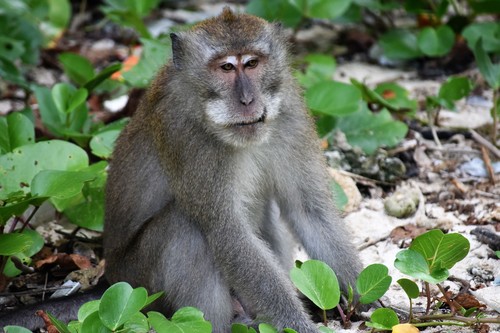
Long-tailed Macaque
Macaca fascicularis
The Long-tailed Macaque is Southeast Asia's most resilient primate, a clever acrobat that navigates both the high canopy and the busy streets of suburban towns. With their expressive faces and complex social lives, they offer a fascinating window into the world of intelligent, adaptable mammals.
Quick Identification
Size
Head-body length of 38–55 cm (15–22 in) with a tail measuring 40–65 cm (16–26 in); weights range from 3–9 kg (7–20 lbs).
Colors
Grayish-brown to reddish-brown coat with a lighter cream-colored underside; faces are pinkish-brown with pale eyelids.
Key Features
- Extremely long tail that exceeds the length of the head and body combined
- Proninent 'mustache' or cheek whiskers in adults
- Pinkish face often with white spots on the eyelids
- Large, social groups usually led by a dominant male
When You’ll See Them
Geographic range
Where Does the Long-tailed Macaque Live?
Native to the tropical regions of Southeast Asia, the Long-tailed Macaque claims a vast territory that stretches across the mainland and thousands of islands. Its core range includes nations such as Thailand, Malaysia, Indonesia, Vietnam, and the Philippines, where it thrives in both dense jungles and coastal mangroves. Beyond its native home, this adaptable primate has been introduced to several locations including Mauritius and parts of Palau, where populations have become well-established in the local ecosystems.
Basemap © OpenStreetMap contributors
Behavior
The Long-tailed Macaque is a highly social and intelligent primate that lives in multi-male, multi-female troops ranging from 10 to over 50 individuals. These groups are matrifocal, meaning females stay with their birth troop for life while males migrate upon reaching maturity. They are diurnal and primarily arboreal, spending much of their time in the canopy, but they are equally comfortable on the ground, especially when foraging in urban or coastal environments.
Known for their synanthropic nature, they have adapted remarkably well to human presence. In many areas, they live in 'temple troops' or suburban populations where they interact daily with people. While they can be playful and curious, they are also highly opportunistic and can become aggressive if they perceive food is available. They demonstrate complex social behaviors including grooming for hygiene and social bonding, and they have been observed using stone tools in coastal regions to crack open shellfish.
EverydayEarth exclusive
Camera Tips
When setting up a trail camera for Long-tailed Macaques, height is your most important variable. These primates are semi-arboreal, so placing your camera at chest height (about 4-5 feet) on a sturdy tree trunk will capture both their ground-foraging behavior and their movement through the lower canopy. If you are in a suburban area, aiming the camera toward a known 'travel route' like a fence line or a specific fruiting tree is much more effective than placing it in an open lawn.
Because macaques are incredibly curious and dexterous, you must secure your camera equipment. They are known to investigate, pull at, and even attempt to open camera housings. Using a steel security box (bear box) and a heavy-duty master lock is highly recommended to prevent your equipment from being damaged or 'relocated' by a curious juvenile. Avoid using shiny or dangling locks that might attract their attention; matte-finish security cables are better.
In terms of settings, use a fast shutter speed or a short burst mode. Macaques move quickly and travel in groups; a single photo might capture the lead male, but a 3-shot burst or a 15-second video will capture the fascinating social dynamics of the entire troop trailing behind. Since they are diurnal, you don't need to worry much about infrared flash range, but ensure your camera isn't facing directly into the morning or evening sun, as the 'golden hour' is when they are most active.
While baiting is possible with fruit or seeds, it is often discouraged in suburban areas as it can habituate the monkeys to human-provided food, leading to conflict. Instead, focus your camera on natural attractants like a ripening fig tree or a water source. If you are in a coastal area, setting a camera near the tide line during low tide can capture unique tool-using behaviors as they forage for crabs and snails.
Similar Species
Species that look similar or are commonly confused with Long-tailed Macaque.
Rhesus Macaque
Has a much shorter tail (about half the body length) and a more robust, stocky build compared to the slender Long-tailed Macaque.
Southern Pig-tailed Macaque
Easily identified by its short, thin tail that is carried arched over the back like a pig's tail, and its larger overall body size.
Frequently Asked Questions
Record Long-tailed Macaque at your habitat
Connect a camera to start building your own species record — AI identifies every visitor automatically.